Showing posts with label AMAIC Australian Marian Academy of the Immaculate Conception biblical identifications Damien F. Mackey Revised History Era King Hezekiah Judah post-graduate Tiglath-pileser John R. Salverda. Show all posts

Sunday, July 26, 2020

Pearl of Great Price


10 The Pearl of Great Price - Matthew 13: 45-46 "All things should ...


Pope Francis said that the “decisive and radical” decision to give up everything to seek even more precious treasures shows that “the building of the Kingdom requires not only the grace of God,

but also the active willingness of the human person.”


Pope Francis: Becoming restless seekers of the Kingdom of Heaven


·                  POPE FRANCIS

·                  ANGELUS


Pope Francis says we are called to become “healthily restless seekers of the Kingdom of Heaven,” as he reflects on the parables of the treasure hidden in the field and the pearl of great value during the Sunday Angelus.


By Christopher Wells


At the Angelus on Sunday, Pope Francis reflected on two of the parables told by Jesus in the day’s Gospel: that of the treasure hidden in the field, and that of the pearl of great value.

In both parables, those who finds the “precious” items, that which is most dear to them, sell everything they have in order to obtain them. “With these two similes,” said Pope Francis, “Jesus proposes to involve us in the building of the Kingdom of Heaven, presenting one of its essential characteristics: Those who fully pledge themselves to the Kingdom are those who are willing to stake everything.”


Healthily restless seekers


“We are called to assume the attitude of these Gospel figures,” Pope Francis continued, “so that we too may become healthily restless seekers of the Kingdom of Heaven.” As in the parables, this involves a cost: we must give up “worldly sureties” – such as “covetousness for possessions, the thirst for profit and power, and thinking only of ourselves” – which can hinder our search.


Too often, said the Pope, people lead “mediocre and dull lives, because they do not go in search of real treasure.” Seeking after the Kingdom of Heaven, on the other hand, is the very “opposite of a dull life: it is a treasure that renews life every day and leads it to extend towards wider horizons.” Seekers after the Kingdom “have a creative and inquisitive heart” leading them to “new paths” for loving God, our neighbour, and ourselves.


The adventure of holiness


“Jesus, Who is the hidden treasure and the pearl of great value, cannot but inspire joy, all the joy in the world,” said Pope Francis: “the joy of discovering a meaning in life, the joy of committing oneself to the adventure of holiness.”

Pope Francis concluded his reflection with the prayer that the Blessed Virgin Mary “might help us to seek after the treasure of the Kingdom of Heaven every day, so that the love God has given us through Jesus may be manifested in our words and acts.”


Wednesday, July 22, 2020

Cardinal Scola calls out Pope Francis’ critics: ‘The pope is the pope’


Cardinal Angelo Scola, the runner-up in the last papal conclave, has twice in recent weeks come out strongly against those, especially within the church, who frequently and increasingly attack Pope Francis. “It’s a very strong sign of contradiction and denotes a certain weakening of the people of God, above all of the intellectual class,” he said. “It is a profoundly wrong attitude because it forgets that ‘the pope is the pope.’”
“It is not by affinity of temperament, of culture, of sensibility, or for friendship, or because one shares or does not share his affirmations that one acknowledges the meaning of the pope in the church,” the cardinal said in an interview published on the Archdiocese of Milan’s website on the occasion of the 50th anniversary of his priestly ordination on July 18.
“[The pope] is the ultimate, radical and formal guarantor—certainly, through a synodal exercise of the Petrine ministry—of the unity of the church,” the cardinal, theologian and former rector of the Pontifical Lateran University stated.
Cardinal Angelo Scola, the runner-up in the last papal conclave, has come out strongly against those who frequently and increasingly attack Pope Francis.

Tuesday, November 5, 2019

Père M-J. Lagrange’s exegetical blancmange


Lagrange portrait manteau.jpg

 
by
 
Damien F. Mackey


“To take the Genesis account as historical information … its value is
simply nil in informing us about what happened “in the night of times”.”
 
M. Lagrange


Dr. Dominque Tassot, writing an article, “The Influence of Geology on Catholic Exegesis”, for the Kolbe Center for the Study of Creation, tells us something about the opinions of M. Lagrange:
 
…. On June 30, 1909, the Pontifical Biblical Commission granted liberty to Catholic exegetes to consider the word “yom” either in its proper meaning or in a broader meaning (sensu improprio) of indeterminate duration (DS 2128). In 1896, Fr Lagrange (who had founded Jerusalem’s Biblical College in 1893) rejected “concordism,” considering that the hexameron days and geological periods did not correspond.
The shaping of the Earth went on a long time after the appearance of life; plants and animals developed in parallel. But remains established the fact that the Earth took a considerable time to form. We renounced forever the historic precise duration of six 24 hours days.7
 
My comment: The ‘Six Days’ of Genesis One, real 24-hour days, have nothing whatsoever to do with the duration of God’s work of creation, and it is futile to attempt to make them fit so-called scientific views about origins, such as the ‘Big Bang’, or an evolutionary-based geology: 
 
What exactly is Creation Science? Part One: Our Western obsession with 'Science'
 
 
Some have observed that the ‘Six Days’ (Hexaëmeron) may be a revelation of a creation already effected. Dr. Tassot continues:
 
The further influence of Lagrange on Catholic exegesis is indisputable: he devised the three main ways to render the presence of scientific errors in the Bible acceptable. These were set out in five lectures given at the Catholic Institute of Toulouse a century ago, in November 1902, later published under the title The Historical Method. I will not dispute Lagrange’s dedication to the Church and the Bible. But we will touch here upon the direct influence of geology on the exegesis of the 20th century through Lagrange’s ideas.
When a schoolboy, Lagrange used to wander with his uncle, a geologist, in the foothills of the Alps, where he lived. Maybe this explains how readily and completely he accepted the long ages, not only for the earth but also for the history of Man. He wrote in the Biblical Review, which he founded:
 
Mankind is older than one believed when piously collecting the wrecks of remembrances assumed to be primitive. (…) Humanly speaking, oral transmission from the beginning of the world is supremely unbelievable. (…) To take the Genesis account as historical information, … its value is simply nil in informing us about what happened “in the night of times.”
 
So Lagrange invented a new and paradoxical concept: “Legendary primitive history.” The Fall, the Curse, the Flood are neither true history nor simple myth. Genesis gives an account based on a “generating fact” but inevitably distorted and downgraded by the transmission through thousands of generations. Another such concept is that of “historical appearances.” Here Lagrange tried to transpose to history what Leo XIIIth said in Providentissimus Deus about astronomy (the Galileo affair!), that the Bible speaks “according to appearances.”
From a Thomistic perspective, our senses give a true path to knowledge. But in the Kantian perspective of that time, “appearance” meant the opposite of reality. In 1919, Lagrange abandoned his theory of “historical appearances,” but the idea remained that the Bible had to be confined to the sphere of religion, and this was indeed the most secure way to prevent any conflict with science.
The third method proposed by Lagrange to explain supposed natural science errors in the Bible was the theory of “literary genres.” The idea underlying this explanation was that one does not deceive when simply asserting the false, but only when teaching it:
 
All that the sacred writers teach, God also teaches and this is true. But what do the sacred writers really teach? What they affirm categorically. But—it has been said for a long time—the Bible is not a collection of categorical theses or affirmations. There are such literary genres where nothing is taught concerning the reality of the facts. They only serve as basis for a moral teaching.”8 [And further:] “It is impossible that God teaches errors. Of course [there are places in] the Bible, where everybody is speaking errors; but it is impossible that an intelligent examination of the Bible compels us to conclude that God taught errors.”9
 
It is obvious that an intelligent use of these three methods is sufficient to get rid of any difficult passage of the Bible. But the authority of the Sacred Writings disappears at the same time, divine inspiration and inerrancy being inseparable!
[End of quotes]
 
We could term this method of exegesis as emptying the Bible of all of its meaning.
 
Père Marie-Joseph Lagrange (1855-1938) was a Dominican (OP) priest and the Dominicans figure rather prominently in my life inasmuch as OP priests celebrate Masses at the University of Sydney (St. John Paul II) chapel and at Notre Dame University (St. Benedict’s), at both of which places I attend several times a week.
The day that a well-informed friend of mine queried, in an e-mail, the strange biblical views that have emanated from the École Biblique which père Lagrange himself founded in Jerusalem, I happened to attend a Mass at the University of Sydney chapel celebrated by a learned Dominican priest. I thought that I must tell him about the concerned e-mail letter that I had just received, I being particularly interested to get his (Dominican) reaction.
He is a scholar, basically a theologian, who seems to flit effortlessly around Latin, Greek, Hebrew, and French for starters. It soon became clear to me, though, that the Scriptures were essentially, for him, about theology - fair enough - but that what my colleagues and I would consider to be historical accounts were written late, perhaps beginning “about 900 BC”, and that “Moses and Joshua could not personally have written about contemporary events, nor did they record dates”. He also made the typical comment that the early Scriptures would have been passed on by means of “oral tradition”. Also fair enough, but the written aspect always seems to get downplayed. Whilst some of this was starting to rub with me, especially that Moses and Joshua did not write down the biblical events of the time, I did not feel inclined to become argumentative or contrary with a man who has an easy-going, genial nature.
But, at the same time, I tried to push home some bullet points, such as:
 
  • God told Moses and Joshua to “write”.
 
  • Moses, in Egypt, was already a learned man and a scribe. [Cf. Acts 7:22]
 
“Yes”, he replied, “but he did not write in Hebrew, but in Egyptian”.
 
Some of what the priest said here is, I believe, just plain wrong, and smacks of what I find that père Lagrange had written decades earlier.
 
Deferring to the Numbers (Chronology) Men
 
Whilst I (and apparently Monty Python) find accountancy, numbers, to be utterly BORING:
 
Counsellor: (John Cleese) Ah Mr Anchovy. Do sit down.
Anchovy: (Michael Palin) Thank you. Take the weight off the feet, eh?
Counsellor: Yes, yes.
Anchovy: Lovely weather for the time of year, I must say.
Counsellor: Enough of this gay banter. And now Mr Anchovy, you asked us to advise you which job in life you were best suited for.
Anchovy: That is correct, yes.
Counsellor: Well I now have the results here of the interviews and the aptitude tests that you took last week, and from them we've built up a pretty clear picture of the sort of person that you are. And I think I can say, without fear of contradiction, that the ideal job for you is chartered accountancy.
Anchovy: But I am a chartered accountant.
Counsellor: Jolly good. Well back to the office with you then.
Anchovy: No! No! No! You don't understand. I've been a chartered accountant for the last twenty years. I want a new job. Something exciting that will let me live.
Counsellor: Well chartered accountancy is rather exciting isn't it?
Anchovy: Exciting? No it's not. It's dull. Dull. Dull. My God it's dull, it's so desperately dull and tedious and stuffy and boring and des-per-ate-ly DULL.  ….
 
numbers appear to be greatly revered in modern times. Numbers seem to have replaced ideas.
It probably has something to do with the power that measuring offers, and, even, of man’s seeking to be ‘the measure of all things’. See e.g. my article:
 
The Futile Aspiration to Make ‘Man the Measure of All Things’
 
 
Mathematics makes a wonderful servant, but it can be a very cruel taskmaster.
Chronologists are the powerful numbers men of (ancient) history.
In Egyptology, historians and archaeologists deferred to the ‘superior wisdom’ of the numbers man, Berlin School chronologist, Eduard Meyer (c. 1906), and allowed him to create a chronology of dynastic Egypt that has little bearing on reality. See e.g. my:


Was Meyer, the numbers man, dull?
“The late great Classical scholar Werner Jaeger once said that the only time the lectures of the immortal Eduard Meyer were really interesting and the only time he was ever able to fill his lecture hall at the University of Berlin was when he talked about the Mormons”.
Enough said!
Meyer’s artificial dating of the Egyptian dynasties did not fit the shorter histories of, say, the Greeks and the Hittites. So, to save the situation, a massive slice of ‘Dark Ages’ (1200-700 BC) had to be inserted into these histories in order to ‘make’ them align with Egypt.
These ‘Dark Ages’ did not occur in real history, and their insertion has caused a disruption to the proper sequence of Greek and Hittite history.
Henk Spaan tells briefly what happened and how Dr. I. Velikovsky had identified the problem: http://www.henkspaan2.nl/velikovsky/15darkages.php
 
The history of ancient Greece is usually divided into several periods. The Archaic period is the time of ancient Hellas, that ran until about 1200 BC and ended shortly after the Trojan War. During this period Mycenae was the centre. Then followed a period of decline, the Greek Middle Ages, also called Dark Ages, when the country was invaded by primitive Dorians. The Greek heyday that we call Classical Greece, when Athens was the main centre, lasted from about 700 to 323 BC. Finally there is the Hellenistic period that begins with the conquests of Alexander the Great throughout the Middle East. In the Hellenistic period, Alexandria was the centre and the period lasted until the Roman conquest of Egypt.

The part of Velikovsky's work dealing with "the dark ages of Greece" never appeared in print. Velikovsky worked on it in the last years of his life, but could not finish it. It is published in the Internet archive of his work entitled "The Dark Age of Greece".

The Mycenaean civilization is closely linked to the 18th Dynasty of Egypt. During excavations in Mycenae, many objects from the 18th Dynasty were found and vice versa in Akhet-Aten, the city that Akhnaton had built, much Mycenaean pottery was found. This means that there must have been a period of more than 500 years between Archaic Greece that existed until 1200 BC and Classical Greece that began around 700 BC. This period is called a dark age because we know little or nothing about it and little remains of this period are found. Understanding those 500 years is difficult, because 500 years of human activity, however primitive, must have left traces above the remains of Mycenaean civilization and there must have been rulers, however barbaric, about whom people wrote of with fear or surprise. However, those traces are not there and neither are the stories. Of the Greek Middle Ages we know of no people like Vikings or Charlemagne of AD history.

Yet, if we move the Mycenaean civilization to 500 years later, it will be closer in line with the rise of Classical Greece and we are then more in line with what, for example, Herodotus and other Greek historians thought about their past. Furthermore, many problems become easier. For example, the famous riddle: how could Homer write a detailed report of the Trojan War if the war took place more than 500 years before Homer wrote his work?
 
[End of quote]
 
Thus, when the likes of W.F. Albright, in close alliance with the École Biblique, attempted to date Joshua’s Jericho, the absence of any Mycenaean pottery at the site meant that - at least according to what Eduard Meyer had established chronologically about the Egypt of the same time, that it was to be dated to c. 1400 BC - the Jericho destruction would inevitably have to be shifted back centuries before this time.
A major part in all of this was played by another (pottery-) chronologist (numbers man) and another Dominican, père Louis-Hugues Vincent, who joined the École Biblique only a year after it was founded. Of course, coming for a Lagrangian background, père Vincent was always going to be operating from a base of biblical fluidity.  
He, being a pottery-chronologist, was accorded a respect similar to that of the ‘expert’, Meyer. Consequently, we now find ourselves in the situation in which the biblical events have been separated from their right archaeology and history by many centuries – almost a millennium in the case of the famous Jericho incident. 
One of my correspondent’s main concerns was that this - the Bible’s no longer fitting with the textbook history - was one of the reasons why many dismiss much of the Scriptures as being myth or fantasy, having little in the way of historical credibility. 
“Didactic fiction” is how one elderly Dominican in Sydney has described the Book of Jonah.
 
Not that the Bible is essentially about history, or science, of course.
For the Dominican priest to whom I spoke, it is really about “theology”.
According to pope Francis, in Aperuit Illis, it is about “our salvation” (# 9):
 
The Bible is not a collection of history books or a chronicle, but is aimed entirely at the integral salvation of the person. The evident historical setting of the books of the Bible should not make us overlook their primary goal, which is our salvation.
 
It is clear from this, though, that the biblical books have an “evident historical setting”, contrary to Lagrange’s view that early Genesis is pre-historical, but also non-historical (see below).
Dei Verbum even has “our first parents” (Cardinal Pell take note), Abraham, Moses, and so on.
 
3. God, who through the Word creates all things (see John 1:3) and keeps them in existence, gives men an enduring witness to Himself in created realities (see Rom. 1:19-20). Planning to make known the way of heavenly salvation, He went further and from the start manifested Himself to our first parents. Then after their fall His promise of redemption aroused in them the hope of being saved (see Gen. 3:15) and from that time on He ceaselessly kept the human race in His care, to give eternal life to those who perseveringly do good in search of salvation (see Rom. 2:6-7). Then, at the time He had appointed He called Abraham in order to make of him a great nation (see Gen. 12:2). Through the patriarchs, and after them through Moses and the prophets, He taught this people to acknowledge Himself the one living and true God, provident father and just judge, and to wait for the Savior promised by Him, and in this manner prepared the way for the Gospel down through the centuries. ….
 
M. Lagrange, on the other hand, according to the following, denied early Genesis historicity: https://exhibitions.lib.cam.ac.uk/dominicans/artifacts/the-bible-in-context/
 
His major challenge, however, would be to establish for fellow Catholics the importance of the Bible’s literary and historical contexts while still proclaiming it to be the Word of God.
To promote Catholic biblical scholarship Lagrange founded first the periodical Revue biblique which was to publish articles on exegesis by teachers at the Jerusalem school and elsewhere, and second Études bibliques, a series of commentaries which began with a study of Judges published in 1903. Church censorship was a continual possibility.
 
 
Lagrange challenged in his lectures and articles the Mosaic authorship of the Pentateuch, and he denied the historicity (though not the truth) of the creation narrative in Genesis 1–11. As a result, he found himself forbidden to publish a commentary on Genesis.
[End of quote]
 
The Dominican priest to whom I spoke did not actually deny an Adam and an Eve, but said: “The first man and woman are called Adam and Eve in Genesis, but these would not have been their real names as they are Hebrew names”.
 
I also advanced this bullet point:
 
  • The JEDP sources that scholars claim to identify in the Book of Genesis are not fundamentally the sources from which Genesis was compiled. These latter are the toledôt divisions, to be read as endings of family histories, the histories of the pre-Moses patriarchs.
 
Whilst the priest was familiar with toledôt, he did not comment on my insistence that they were endings, not headings. He admitted to being uncomfortable with JEDP – “you can’t preach it”.
I also recalled to him the case of the French Catholic physician, Jean Astruc, really a pioneer of the modern documentary sources, who had intuitively discerned that the Flood account in Genesis appeared to have been composed from more than one source. The toledôt perfectly accounts for that, of course, it having been written by Noah’s three sons.
The next series, I said, was signed off only by Shem, who must by then have become separated from his brothers, Ham and Japheth. 
Furthermore, I said, scholars who deny the influence of Moses in the compilation of the Pentateuch may not have any expertise in the ancient Egyptian language, and are not able, therefore, to discern a prevailing Egyptian influence throughout much of those books - this being an indication that these books, in their original states (before later editing) were written at an early point in time when Israel had been in close contact with Egypt, and not written in a later Babylonian period as the documentists insist.
I queried that, if the early Bible were not really historically or archaeologically relevant, why was it that there is a substantial archaeology underlying e.g. the Conquest when properly dated, and not dated according to the whims of the unreliable chronologists. The Middle Bronze I (MBI) people - the priest knew of them - basically trace the same geographical pattern as do the Exodus Israelites, and they are known to have been bearing Egyptian artefacts. But conventional historians (the more biblically-minded ones) tend to identify the partially nomadic MBI as belonging to the time of Abram (Abraham). Once we fix Abram to his right stratigraphical level, however, which is Late Chalcolithic/Early Bronze I, we can identify the destruction caused by the four invading kings as narrated in Genesis 14, Amraphel of Shinar and his confederacy.
 
All of this is a real history, with a real underpinning archaeology.

Monday, October 28, 2019

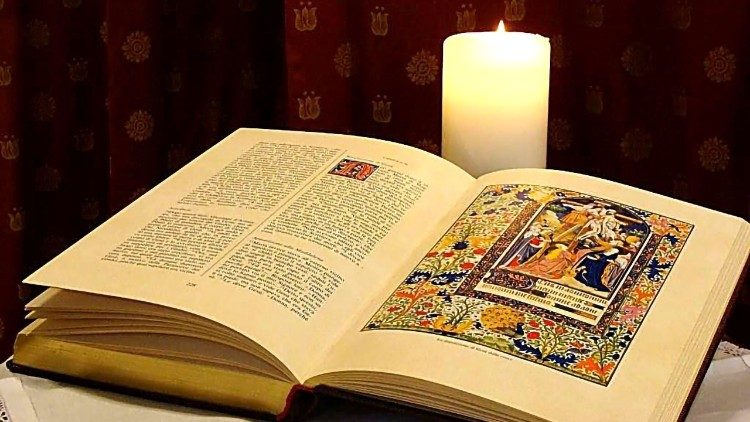
INSTITUTING THE SUNDAY OF THE WORD OF GOD


Sacred Scriptures


APOSTOLIC LETTER
ISSUED "MOTU PROPRIO"
BY THE SUPREME PONTIFF
FRANCIS
APERUIT ILLIS
INSTITUTING THE
SUNDAY OF THE WORD OF GOD


1. “He opened their minds to understand the Scriptures” (Lk 24:45).  This was one of the final acts of the risen Lord before his Ascension.  Jesus appeared to the assembled disciples, broke bread with them and opened their minds to the understanding of the sacred Scriptures. To them, amid their fear and bewilderment, he unveiled the meaning of the paschal mystery: that in accordance with the Father’s eternal plan he had to suffer and rise from the dead, in order to bring repentance and the forgiveness of sins (cf. Lk 24:26.46-47). He then promised to send the Holy Spirit, who would give them strength to be witnesses of this saving mystery (cf. Lk 24:49).
The relationship between the Risen Lord, the community of believers and sacred Scripture is essential to our identity as Christians. Without the Lord who opens our minds to them, it is impossible to understand the Scriptures in depth. Yet the contrary is equally true: without the Scriptures, the events of the mission of Jesus and of his Church in this world would remain incomprehensible. Hence, Saint Jerome could rightly claim: “Ignorance of the Scriptures is ignorance of Christ” (Commentary on the Book of Isaiah, Prologue: PL 24,17B).
2. At the conclusion of the Extraordinary Jubilee of Mercy, I proposed setting aside “a Sunday given over entirely to the word of God, so as to appreciate the inexhaustible riches contained in that constant dialogue between the Lord and his people” (Misericordia et Misera, 7). Devoting a specific Sunday of the liturgical year to the word of God can enable the Church to experience anew how the risen Lord opens up for us the treasury of his word and enables us to proclaim its unfathomable riches before the world. Here, we are reminded of the teaching of Saint Ephrem: “Who is able to understand, Lord, all the richness of even one of your words? There is more that eludes us than what we can understand. We are like the thirsty drinking from a fountain. Your word has as many aspects as the perspectives of those who study it. The Lord has coloured his word with diverse beauties, so that those who study it can contemplate what stirs them. He has hidden in his word all treasures, so that each of us may find a richness in what he or she contemplates” (Commentary on the Diatessaron, 1, 18).
With this Letter, I wish to respond to the many requests I have received from the people of God that the entire Church celebrate, in unity of purpose, a Sunday of the Word of God. It is now common for the Christian community to set aside moments to reflect on the great importance of the word of God for everyday living. The various local Churches have undertaken a wealth of initiatives to make the sacred Scripture more accessible to believers, to increase their gratitude for so great a gift, and to help them to strive daily to embody and bear witness to its teachings.
The Second Vatican Council gave great impulse to the rediscovery of the word of God, thanks to its Dogmatic Constitution Dei Verbum, a document that deserves to be read and appropriated ever anew. The Constitution clearly expounds the nature of sacred Scripture, its transmission from generation to generation (Chapter II), its divine inspiration (Chapter III) embracing the Old and New Testaments (Chapters IV and V), and the importance of Scripture for the life of the Church (Chapter VI). To advance this teaching, Pope Benedict XVI convoked an Assembly of the Synod of Bishops in 2008 on “The Word of God in the Life and Mission of the Church”, and then issued the Apostolic Exhortation Verbum Domini, whose teaching remains fundamental for our communities.[1] That document emphasizes in particular the performative character of the Word of God, especially in the context of the liturgy, in which its distinctively sacramental character comes to the fore.[2]
It is fitting, then that the life of our people be constantly marked by this decisive relationship with the living word that the Lord never tires of speaking to his Bride, that she may grow in love and faithful witness.
3. Consequently, I hereby declare that the Third Sunday in Ordinary Time is to be devoted to the celebration, study and dissemination of the word of God. This Sunday of the Word of God will thus be a fitting part of that time of the year when we are encouraged to strengthen our bonds with the Jewish people and to pray for Christian unity. This is more than a temporal coincidence: the celebration of the Sunday of the Word of God has ecumenical value, since the Scriptures point out, for those who listen, the path to authentic and firm unity.
The various communities will find their own ways to mark this Sunday with a certain solemnity. It is important, however, that in the Eucharistic celebration the sacred text be enthroned, in order to focus the attention of the assembly on the normative value of God’s word. On this Sunday, it would be particularly appropriate to highlight the proclamation of the word of the Lord and to emphasize in the homily the honour that it is due. Bishops could celebrate the Rite of Installation of Lectors or a similar commissioning of readers, in order to bring out the importance of the proclamation of God’s word in the liturgy. In this regard, renewed efforts should be made to provide members of the faithful with the training needed to be genuine proclaimers of the word, as is already the practice in the case of acolytes or extraordinary ministers of Holy Communion. Pastors can also find ways of giving a Bible, or one of its books, to the entire assembly as a way of showing the importance of learning how to read, appreciate and pray daily with sacred Scripture, especially through the practice of lectio divina.
4. The return of the people of Israel to their homeland after the Babylonian exile was marked by the public reading of the book of the Law. In the book of Nehemiah, the Bible gives us a moving description of that moment. The people assembled in Jerusalem, in the square before the Water Gate, to listen to the Law. They had been scattered in exile, but now they found themselves gathered “as one” around the sacred Scripture (Neh 8:1). The people lent “attentive ears” (Neh 8:3) to the reading of the sacred book, realizing that in its words they would discover the meaning of their lived experience. The reaction to the proclamation of was one of great emotion and tears: “[The Levites] read from the book, from the law of God, clearly; and they gave the sense, so that the people understood the reading. And Nehemiah, who was the governor, and Ezra the priest and scribe, and the Levites who taught the people said to all the people, ‘This day is holy to the Lord your God; do not mourn or weep’. For all the people wept when they heard the words of the law. Then he said to them, ‘Go your way, eat the fat and drink sweet wine and send portions to him for whom nothing is prepared; for this day is holy to our Lord; and do not be grieved, for the joy of the Lord is your strength’” (Neh 8:8-10).
These words contain a great teaching. The Bible cannot be just the heritage of some, much less a collection of books for the benefit of a privileged few. It belongs above all to those called to hear its message and to recognize themselves in its words. At times, there can be a tendency to monopolize the sacred text by restricting it to certain circles or to select groups. It cannot be that way. The Bible is the book of the Lord’s people, who, in listening to it, move from dispersion and division towards unity. The word of God unites believers and makes them one people.
5. In this unity born of listening, pastors are primarily responsible for explaining sacred Scripture and helping everyone to understand it. Since it is the people’s book, those called to be ministers of the word must feel an urgent need to make it accessible to their community.
The homily, in particular, has a distinctive function, for it possesses “a quasi-sacramental character” (Evangelii Gaudium, 142). Helping people to enter more deeply into the word of God through simple and suitable language will allow priests themselves to discover the “beauty of the images used by the Lord to encourage the practice of the good” (ibid.). This is a pastoral opportunity that should not be wasted!
For many of our faithful, in fact, this is the only opportunity they have to grasp the beauty of God’s word and to see it applied to their daily lives. Consequently, sufficient time must be devoted to the preparation of the homily. A commentary on the sacred readings cannot be improvised. Those of us who are preachers should not give long, pedantic homilies or wander off into unrelated topics. When we take time to pray and meditate on the sacred text, we can speak from the heart and thus reach the hearts of those who hear us, conveying what is essential and capable of bearing fruit. May we never tire of devoting time and prayer to Scripture, so that it may be received “not as a human word but as what it really is, the word of God” (1 Thess 2:13).
Catechists, too, in their ministry of helping people to grow in their faith, ought to feel an urgent need for personal renewal through familiarity with, and study of, the sacred Scriptures. This will help them foster in their hearers a true dialogue with the word of God.
6. Before encountering his disciples, gathered behind closed doors, and opening their minds to the understanding of the Scriptures (cf. Lk 24:44-45), the risen Lord appeared to two of them on the road to Emmaus from Jerusalem (cf. Lk 24:13-35). Saint Luke’s account notes that this happened on the very day of his resurrection, a Sunday. The two disciples were discussing the recent events concerning Jesus’ passion and death. Their journey was marked by sorrow and disappointment at his tragic death. They had hoped that he would be the Messiah who would set them free, but they found themselves instead confronted with the scandal of the cross. The risen Lord himself gently draws near and walks with them, yet they do not recognize him (cf. v. 16). Along the way, he questions them, and, seeing that they have not grasped the meaning of his passion and death, he exclaims: “O foolish men, and slow of heart” (v. 25). Then, “beginning with Moses and all the prophets, he interpreted to them the things about himself in all the Scriptures” (v.27). Christ is the first exegete! Not only did the Old Testament foretell what he would accomplish, but he himself wished to be faithful to its words, in order to make manifest the one history of salvation whose fulfilment is found in Christ.
7. The Bible, as sacred Scripture, thus speaks of Christ and proclaims him as the one who had to endure suffering and then enter into his glory (cf. v. 26). Not simply a part, but the whole of Scripture speaks of Christ. Apart from the Scriptures, his death and resurrection cannot be rightly understood. That is why one of the most ancient confessions of faith stressed that “Christ died for our sins in accordance with the Scriptures, that he was buried, that he was raised on the third day in accordance with the Scriptures, and that he appeared to Cephas” (1Cor15:3-5). Since the Scriptures everywhere speak of Christ, they enable us to believe that his death and resurrection are not myth but history, and are central to the faith of his disciples.
A profound bond links sacred Scripture and the faith of believers. Since faith comes from hearing, and what is heard is based on the word of Christ (cf. Rom 10:17), believers are bound to listen attentively to the word of the Lord, both in the celebration of the liturgy and in their personal prayer and reflection.
8. The journey that the Risen Lord makes with the disciples of Emmaus ended with a meal. The mysterious wayfarer accepts their insistent request: “Stay with us, for it is almost evening and the day is now far spent” (Lk 24:29). They sit down at table, and Jesus takes the bread, blesses it, breaks it and offers it to them. At that moment, their eyes are opened, and they recognize him (cf. v. 31).
This scene clearly demonstrates the unbreakable bond between sacred Scripture and the Eucharist. As the Second Vatican Council teaches, “the Church has always venerated the divine Scriptures as she has venerated the Lord’s body, in that she never ceases, above all in the sacred liturgy, to partake of the bread of life and to offer it to the faithful from the one table of the word of God and the body of Christ” (Dei Verbum, 21).
Regular reading of sacred Scripture and the celebration of the Eucharist make it possible for us to see ourselves as part of one another. As Christians, we are a single people, making our pilgrim way through history, sustained by the Lord, present in our midst, who speaks to us and nourishes us. A day devoted to the Bible should not be seen as a yearly event but rather a year-long event, for we urgently need to grow in our knowledge and love of the Scriptures and of the risen Lord, who continues to speak his word and to break bread in the community of believers. For this reason, we need to develop a closer relationship with sacred Scripture; otherwise, our hearts will remain cold and our eyes shut, struck as we are by so many forms of blindness.
Sacred Scripture and the sacraments are thus inseparable. When the sacraments are introduced and illumined by God’s word, they become ever more clearly the goal of a process whereby Christ opens our minds and hearts to acknowledge his saving work. We should always keep in mind the teaching found in the Book of Revelation: the Lord is standing at the door and knocking. If anyone should hear his voice and open for him, he will come in and eat with them (cf. 3:20). Christ Jesus is knocking at our door in the words of sacred Scripture. If we hear his voice and open the doors of our minds and hearts, then he will enter our lives and remain ever with us.
9. In the Second Letter to Timothy, which is in some ways his spiritual testament, Saint Paul urges his faithful co-worker to have constant recourse to sacred Scripture. The Apostle is convinced that “all Scripture is inspired by God and profitable for teaching, for reproof, for correction, and for training in righteousness” (3:16). Paul’s exhortation to Timothy is fundamental to the teaching of the conciliar Constitution Dei Verbum on the great theme of biblical inspiration, which emphasizes the Scriptures’ saving purpose, spiritual dimension and inherent incarnational principle.
First, recalling Paul’s encouragement to Timothy, Dei Verbum stresses that “we must acknowledge that the books of Scripture firmly, faithfully and without error, teach that truth which God, for the sake of our salvation, wished to see confided to the sacred Scriptures” (No. 11). Since the Scriptures teach with a view to salvation through faith in Christ (cf. 2 Tim 3:15), the truths contained therein are profitable for our salvation. The Bible is not a collection of history books or a chronicle, but is aimed entirely at the integral salvation of the person. The evident historical setting of the books of the Bible should not make us overlook their primary goal, which is our salvation. Everything is directed to this purpose and essential to the very nature of the Bible, which takes shape as a history of salvation in which God speaks and acts in order to encounter all men and women and to save them from evil and death.
To achieve this saving purpose, sacred Scripture, by the working of the Holy Spirit, makes human words written in human fashion become the word of God (cf. Dei Verbum, 12). The role of the Holy Spirit in the Scriptures is primordial. Without the work of the Spirit, there would always be a risk of remaining limited to the written text alone. This would open the way to a fundamentalist reading, which needs to be avoided, lest we betray the inspired, dynamic and spiritual character of the sacred text. As the Apostle reminds us: “The letter kills, but the Spirit gives life” (2 Cor 3:6). The Holy Spirit, then, makes sacred Scripture the living word of God, experienced and handed down in the faith of his holy people.
10. The work of the Holy Spirit has to do not only with the formation of sacred Scripture; it is also operative in those who hear the word of God. The words of the Council Fathers are instructive: sacred Scripture is to be “read and interpreted in the light of the same Spirit through whom it was written” (Dei Verbum, 12). God’s revelation attains its completion and fullness in Jesus Christ; nonetheless, the Holy Spirit does not cease to act. It would be reductive indeed to restrict the working of the Spirit to the divine inspiration of sacred Scripture and its various human authors. We need to have confidence in the working of the Holy Spirit as he continues in his own way to provide “inspiration” whenever the Church teaches the sacred Scriptures, whenever the Magisterium authentically interprets them (cf. ibid., 10), and whenever each believer makes them the norm of his or her spiritual life. In this sense, we can understand the words spoken by Jesus to his disciples when they told him that they now understood the meaning of his parables: “Every scribe who has been trained for the kingdom of heaven is like a householder who brings out of his treasure what is new and what is old” (Mt 13:52).
11. Finally, Dei Verbum makes clear that “the words of God, expressed in human language, are in every way like human speech, just as the Word of the eternal Father, in taking upon himself the weak flesh of human beings, also took on their likeness” (No. 13). We can say that the incarnation of the eternal Word gives shape and meaning to the relationship between God’s word and our human language, in all its historical and cultural contingency. This event gives rise to Tradition, which is also God’s word (cf. ibid., 9). We frequently risk separating sacred Scripture and sacred Tradition, without understanding that together they are the one source of Revelation. The written character of the former takes nothing away from its being fully a living word; in the same way, the Church’s living Tradition, which continually hands that word down over the centuries from one generation to the next, possesses that sacred book as the “supreme rule of her faith” (ibid., 21). Moreover, before becoming a written text, the word of God was handed down orally and kept alive by the faith of a people who, in the midst of many others, acknowledged it as their own history and the source of their identity. Biblical faith, then, is based on the living word, not on a book.
12. When sacred Scripture is read in the light of the same Spirit by whom it was written, it remains ever new. The Old Testament is never old once it is part of the New, since all has been transformed thanks to the one Spirit who inspired it. The sacred text as a whole serves a prophetic function regarding not the future but the present of whoever is nourished by this word. Jesus himself clearly stated this at the beginning of his ministry: “Today this Scripture has been fulfilled in your hearing” (Lk 4:21). Those who draw daily nourishment from God’s word become, like Jesus, a contemporary of all those whom they encounter: they are not tempted to fall into sterile nostalgia for the past, or to dream of ethereal utopias yet to come.
Sacred Scripture accomplishes its prophetic work above all in those who listen to it. It proves both sweet and bitter. We are reminded of the words of the prophet Ezekiel when, commanded by the Lord to eat the scroll of the book, he tells us: “It was in my mouth as sweet as honey” (3:3). John the Evangelist too, on the island of Patmos, echoes Ezekiel’s experience of eating the scroll, but goes on to add: “It was sweet as honey in my mouth, but when I had eaten it my stomach was made bitter” (Rev 10:10).
The sweetness of God’s word leads us to share it with all those whom we encounter in this life and to proclaim the sure hope that it contains (cf. 1 Pet 3:15-16). Its bitterness, in turn, often comes from our realization of how difficult it is to live that word consistently, or our personal experience of seeing it rejected as meaningless for life. We should never take God’s word for granted, but instead let ourselves be nourished by it, in order to acknowledge and live fully our relationship with him and with our brothers and sisters.
13. Yet another challenge raised by sacred Scripture has to do with love. God’s word constantly reminds us of the merciful love of the Father who calls his children to live in love. The life of Jesus is the full and perfect expression of this divine love, which holds nothing back but offers itself to all without reserve. In the parable of Lazarus, we find a valuable teaching. When both Lazarus and the rich man die, the latter, seeing the poor man Lazarus in Abraham’s bosom, asks that Lazarus be sent to his brothers to warn them to love their neighbour, lest they also experience his torment. Abraham’s answer is biting: “They have Moses and the prophets; let them hear them” (Lk 16:29). To listen to sacred Scripture and then to practise mercy: this is the great challenge before us in life. God’s word has the power to open our eyes and to enable us to renounce a stifling and barren individualism and instead to embark on a new path of sharing and solidarity.
14. One of the most significant moments in Jesus’ relationship with his disciples is found in the account of the Transfiguration. He goes up the mountain with Peter, James and John to pray. The evangelists tell us that as Jesus’ face and clothing became dazzlingly white, two men conversed with him: Moses and Elijah, representing respectively the Law and the Prophets; in other words, sacred Scripture. Peter’s reaction to this sight is one of amazement and joy: “Master, it is well that we are here; let us make three tents, one for you and one for Moses and one for Elijah” (Lk 9:33). At that moment a cloud overshadows them, and the disciples are struck with fear.
The Transfiguration reminds us of the Feast of Tabernacles, when Ezra and Nehemiah read the sacred text to the people after their return from exile. At the same time, it foreshadows Jesus’ glory, as a way of preparing the disciples for the scandal of the Passion: that divine glory is also evoked by the cloud enveloping the disciples as a symbol of God’s presence. A similar transfiguration takes place with sacred Scripture, which transcends itself whenever it nourishes the lives of believers. As the Apostolic Exhortation Verbum Domini reminds us: “In rediscovering the interplay between the different senses of Scripture it becomes essential to grasp thepassage from letter to spirit. This is not an automatic, spontaneous passage; rather, the letter needs to be transcended” (No. 38).
15. Along our path of welcoming God’s word into our hearts, the Mother of the Lord accompanies us. She is the one who was called blessed because she believed in the fulfilment of what the Lord had spoken to her (cf. Lk 1:45). Mary’s own beatitude is prior to all the beatitudes proclaimed by Jesus about the poor and those who mourn, the meek, the peacemakers and those who are persecuted, for it is the necessary condition for every other kind of beatitude. The poor are not blessed because they are poor; they become blessed if, like Mary, they believe in the fulfilment of God’s word. A great disciple and master of sacred Scripture, Saint Augustine, once wrote: “Someone in the midst of the crowd, seized with enthusiasm, cried out: ‘Blessed is the womb that bore you’ and Jesus replied, ‘Rather, blessed are they who hear the word of God and keep it’. As if to say: My mother, whom you call blessed, is indeed blessed, because she keeps the word of God. Not because in her the Word became flesh and dwelt among us, but because she keeps that same word of God by which she was made and which, in her womb, became flesh” (Tractates on the Gospel of John, 10, 3).
May the Sunday of the Word of God help his people to grow in religious and intimate familiarity with the sacred Scriptures. For as the sacred author taught of old: “This word is very near to you: it is in your mouth and in your heart for your observance” (Dt 30:14).


Given in Rome, at the Basilica of Saint John Lateran, on 30 September 2019, the liturgical Memorial of Saint Jerome, on the inauguration of the 1600th anniversary of his death.


FRANCISCUS


[1] Cf. AAS 102 (2010), 692-787. [2] “The sacramentality of the word can thus be understood by analogy with the real presence of Christ under the appearances of the consecrated bread and wine.  By approaching the altar and partaking in the Eucharistic banquet we truly share in the body and blood of Christ. The proclamation of God’s word at the celebration entails an acknowledgment that Christ himself is present, that he speaks to us, and that he wishes to be heard”(Verbum Domini, 56).


http://w2.vatican.va/content/francesco/en/motu_proprio/documents/papa-francesco-motu-proprio-20190930_aperuit-illis.html