Friday, March 20, 2020

Pope at Mass: “Let’s return to our Father”


Once again the Pope prays for healthcare providers in the hard hit Bergamo region of Italy during his Mass at the Casa Santa Marta on Friday, and urges us to “return to our Father who is waiting for us”. (With link to playback of live broadcast)
By Vatican News
“Yesterday, I received a message from a priest from the Bergamo region who asked for prayers for the doctors working there…. They are at the end their strength…and are truly giving their lives to help those who are ill, to save others’ lives.” He also prayed for civil leaders who are managing the crisis and often “suffer from being misunderstood”. “They are the pillars helping us move out of the situation and are defending us from this crisis”, the Pope added. “So, let’s pray for them”.

Song from his childhood

The Pope introduced his homily saying the words “return to the Lord, your God, from the first reading from Hosea (14:2), always remind him of a song sung by Carlo Buti 75 years ago.
"The Italian families in Buenos Aires used to listen to it. They liked it a lot. ‘Return to your daddy, he will still sing you a lullaby’. Return. But it’s your Father who tells you to return. God is your Daddy. He’s not a judge. He’s your Daddy. Go back home."


Listen to "Torna Piccina Mia", the song Pope Francis refers to

Father waits for His wayward son

That memory then lead him to the 15th chapter of Luke. There, another Father waits for his son who left home taking “all that money and wasting it”.
"If he sees him from a distance, it’s because He was waiting for him. How many times He went up the terrace day after day, month after months, perhaps years even. He waited for His son."

The Father’s tenderness

This is how God’s shows His tenderness. “It speaks to us especially during Lent”, the Pope said.
"[Lent] is the time to enter into ourselves and to remember the Father and return to our Daddy. ‘But, Father, I’m ashamed to go back because, you know, Father I've …done so many things wrong’. What will the Lord say? ‘Return. I will heal their defection. I will love them freely; for my wrath is turned away from them (Hosea 14:4).’ Return to your Father. The God of tenderness will heal us.”
This Father will heal us of  “so many of life’s wounds”, the Pope explained.
“Going back to God is going back to an embrace, the Father’s embrace, It’s not going to God. No, it’s going back home.”
Listen to our report

Confession when a priest is not available

This habit of returning home “takes flesh in the Sacrament of Reconciliation”, the Pope explained.
“I know that many of you go to confession before Easter… Many will say to me: ‘But Father…I can't leave the house and I want to make my peace with the Lord. I want Him to embrace me… How can I do that unless I find a priest?’. Do what the catechism says. It's very clear. If you don't find a priest to go to confession, speak to God. He's your Father. Tell Him the truth: ‘Lord. I did this and this and this. Pardon me.’ Ask His forgiveness with all your heart with an act of contrition, and promise Him, ‘afterward I will go to confession.’ You will return to God's grace immediately. You yourself can draw near, as the catechism teaches us, to God's forgiveness,s without having a priest at hand.”

Return

At the end of his homily, the Pope expressed the hope that the word “return” might “echo in our ears today”.
“Return to your Daddy. Return to your Father. He’s waiting for you, and He will throw a feast for you.” 


Live broadcast, Mass, Casa Santa

Thursday, March 19, 2020

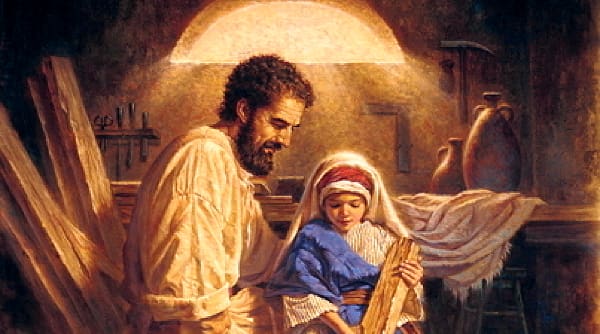
Papal devotion: Especially in times of trial, pope turns to St. Joseph


Cindy Wooden
Mar 19, 2020


ROME - St. Joseph is the patron saint of retired Pope Benedict XVI - Joseph Ratzinger - but Pope Francis’ devotion to the husband of Mary and guardian of Jesus is clear as well.
In fact, at the beginning of his pontificate in 2013, Pope Francis confirmed a directive that Pope Benedict had made, but which had not gone into effect, to include the name of St. Joseph permanently in the Eucharistic prayers used at most Masses in the Latin rite.
Pope Francis formally inaugurated his papacy on St. Joseph’s feast day, March 19, and he has a spikenard, the flower used as a symbol of St. Joseph, on his coat-of-arms.
And he has popularized statues of St. Joseph sleeping - or, better, dreaming - mentioning on many occasions how he places particularly difficult prayer requests under the statue.
Meeting families in the Philippines in January 2015, he told them, “I have great love for St. Joseph because he is a man of silence and strength. On my table I have an image of St. Joseph sleeping. Even when he is asleep, he is taking care of the church.”
The thing is, he said, sleep and dreams are very important in the few mentions of St. Joseph in the Gospel. An angel comes to him in a dream to tell him not to be afraid to take Mary as his wife; later, an angel comes to him in a dream to tell him to flee to Egypt with Mary and the baby Jesus, because Herod wants to kill the child.
The Italian website Vatican Insider reported that Pope Francis had told one of his aides about the statue early on. “You know,” he reportedly said, “you have to be patient with these carpenters: They tell you they’ll have a piece of furniture finished in a couple of weeks and it ends up taking a month even. But they get the job done and they do it well! You just need to be patient.”
Amid Italy’s nationwide lockdown to stem the spread of the coronavirus, Francis spoke about the importance of St. Joseph during his weekly general audience March 18. He said, “In life, in work, in family, in joy and in sorrow, he always looked for and loved the Lord, earning the praise Scripture offers of being a just and wise man. Always invoke him, especially in difficult times, and entrust your lives to this great saint.”
Francis also invited Catholics, especially in the midst of the COVID-19 pandemic, to put their families “under the loving gaze of St. Joseph, guardian of the Holy Family and of our families.”
The next morning, preaching during his livestreamed Mass, the pope said God chose “a just man, a man of faith” to raise his son on earth.
As a carpenter, the pope said, St. Joseph must have been very precise. “He was able to adjust an angle of wood by millimeters; he knew how to do it. He was able to trim a millimeter off the surface of a piece of wood. Right? He was precise. But he also was able to enter into the mystery that he could not control,” the mystery of God’s plan for his life and, especially, the mystery of his son, who was both human and God.
When Pope Francis formally inaugurated his papacy in 2013, he told the crowd in St. Peter’s Square that “St. Joseph appears as a strong and courageous man, a working man, yet in his heart we see great tenderness, which is not the virtue of the weak, but rather a sign of strength of spirit and a capacity for concern, for compassion, for genuine openness to others, for love.”
St. Joseph responded to God’s call to be the guardian and protector of his son “by being constantly attentive to God, open to the signs of God’s presence and receptive to God’s plans, and not simply his own,” he said.

Thursday, March 12, 2020

Read: Pope Francis’s prayer to Mary during coronavirus pandemic


Pope Francis asks Mary's protection for Rome against coronavirus


          O Mary,
you always shine on our path
as a sign of salvation and of hope.
We entrust ourselves to you, Health of the Sick,
who at the cross took part in Jesus' pain, keeping your faith firm.
You, Salvation of the Roman People,
know what we need,
and we are sure you will provide
so that, as in Cana of Galilee,
we may return to joy and to feasting
after this time of trial.
Help us, Mother of Divine Love,
to conform to the will of the Father
and to do as we are told by Jesus,
who has taken upon himself our sufferings
and carried our sorrows
to lead us, through the cross,
to the joy of the resurrection. Amen.
Under your protection, we seek refuge, Holy Mother of God. Do not disdain the entreaties of we who are in trial, but deliver us from every danger, O glorious and blessed Virgin.
https://www.americamagazine.org/faith/2020/03/11/read-pope-francis-prayer-mary-coronavirus-pandemic 

Sunday, March 8, 2020

Pope Francis: Be strong in faith amid coronavirus trial


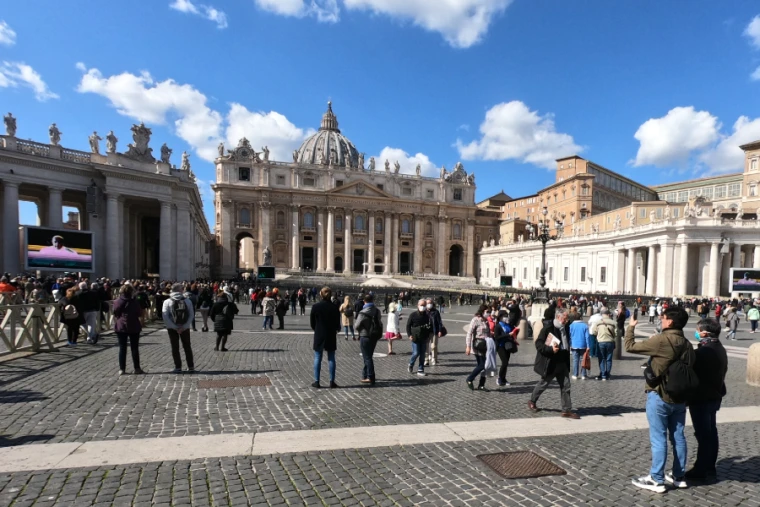
Pilgrims in St. Peter's Square watch video broadcast of the Angelus March 8, 2020. Credit: Miguel Mares.

Pilgrims in St. Peter's Square watch video broadcast of the Angelus March 8, 2020. Credit: Miguel Mares.


.- In a video streamed live to St. Peter’s Square, Pope Francis prayed for those suffering from the "coronavirus epidemic" and encouraged Catholics to live through this trial with the strength of faith.
“I join my brother bishops in encouraging the faithful to live this difficult moment with the strength of faith, the certainty of hope and the fervor of charity,” Pope Francis said March 8.
“The season of Lent helps us all to give an evangelical sense also to this moment of trial and pain,” he added.
The pope led the Sunday Angelus prayer via video filmed in the library of the Apostolic Palace in response to ongoing concerns about the spread of coronavirus in Italy and Vatican City. Traditionally, the pope leads the Angelus from the palace balcony overlooking St. Peter’s Square.
"Today's Angelus prayer is a little strange with the pope ‘caged’ in the library, but I see you, I am close to you,” Pope Francis told the smaller than usual crowd in St. Peter’s Square at the beginning of the video broadcast.
“This way of praying the Angelus today is done to carry out preventive measures, so as to avoid crowds of people, which can favor the transmission of the virus,” he said.
The Italian government imposed a strict quarantine on March 8 for northern and central regions of Italy, including Milan and Venice.
Most of the 5,883 people who have contracted Covid-19 in Italy have been in the northern regions of the country. The Italian Ministry of Health reported 76 confirmed cases in Rome’s Lazio region on the evening of March 7.
With 233 coronavirus-related deaths in Italy in two weeks -- 85 of which have occurred in the past two days -- Italy has had the most Covid-19 mortalities outside of China.
Italy’s museums, archaeological sites, concerts, and  movie theaters have all been closed until April 3, the Italian Minister of Tourism said March 8. All schools and universities will also remain closed throughout the country until March 15.
Pope Francis said March 8 that he is “close in prayer to people suffering from the current coronavirus epidemic.”
Vatican City confirmed its first case of coronavirus on March 5, and later announced that both the pope’s Angelus address and Wednesday general audience would take place over live video.
“The love of Jesus has no measure,” Pope Francis said in the video message. “It is a free, unconditional choice, a free initiative, a divine friendship that asks for nothing in return.”
“Being witnesses of Jesus is a gift that we have not deserved: we feel inadequate, but we cannot hold back with the excuse of our inability,” the pope said.
After the Angelus, Pope Francis appeared in the window of the Apostolic Palace to give a blessing to the pilgrims in St. Peter's Square.
“Jesus says to us too: ‘Stand up and do not be afraid’ … we must not forget that the baptism that we received made us witnesses,” Pope Francis

https://www.catholicnewsagency.com/news/pope-francis-be-strong-in-faith-amid-coronavirus-trial-68834

Wednesday, January 15, 2020

God's word can never be 'enchained,' pope says at audience

godsword650.jpg

Vatican City — A true apostle is one who continues to be a courageous and joyful evangelizer even in the face of persecution and certain death, Pope Francis said.


By choosing to close the Acts of the Apostles not with St. Paul's martyrdom but with his continuing to preach the Gospel even while under house arrest, St. Luke wanted to show that the word of God cannot be "enchained," the pope said Jan. 15 during his weekly general audience.


"This house open to all hearts is the image of the church which — although persecuted, misunderstood and chained — never tires of welcoming with a motherly heart every man and woman to proclaim to them the love of the Father who made himself visible in Jesus," he said.


The pope concluded his series of talks on the Acts of the Apostles with a reflection on St. Paul's imprisonment in Rome.


St. Paul's treacherous journey and adventures to "the heart of the empire," he said, did not weaken the Gospel he preached but instead strengthened it by "showing that the direction of events does not belong to men but to the Holy Spirit, who gives fruitfulness to the church's missionary action."


During his imprisonment, the pope continued, the apostle would meet with notable Jewish people in his efforts to show "the fulfillment of the promises made to the chosen people" through Christ's death and resurrection.


While not everyone was convinced by his preaching, St. Paul continued to welcome anyone "who wanted to receive the proclamation of the kingdom of God and to know Christ," which is a grace that all Christians should pray for, he said.


May the Lord "enable us, like Paul, to imbue our houses with the Gospel and to make them cenacles of fraternity, where we can welcome the living Christ, who comes to meet us in every person and in every age," Francis said.


https://www.ncronline.org/news/vatican/francis-chronicles/gods-word-can-never-be-enchained-pope-says-audience

Thursday, December 12, 2019

Pope calls idea of declaring Mary co-redemptrix ‘foolishness’


Holy Mary and Jesus child Jesus Mother, Blessed Mother Mary, Blessed Virgin Mary, Mother And Child, Religious Icons, Religious Art, Santa Maria, St Therese, Images Of Mary

Inés San Martín

Dec 13, 2019


"She never wanted for herself something that was of her son,” Pope Francis said Thursday. “She never introduced herself as co-redemptrix. No. Disciple,” he said, meaning that Mary saw herself as a disciple of Jesus.


ROME - Pope Francis appeared to flatly reject proposals in some theological circles to add “co-redemptrix” to the list of titles of the Virgin Mary, saying the mother of Jesus never took anything that belonged to her son, and calling the invention of new titles and dogmas “foolishness.”
“She never wanted for herself something that was of her son,” Francis said. “She never introduced herself as co-redemptrix. No. Disciple,” he said, meaning that Mary saw herself as a disciple of Jesus.
Mary, the pope insisted, “never stole for herself anything that was of her son,” instead “serving him. Because she is mother. She gives life.”
Francis’s words, delivered in Spanish, came while celebrating a Thursday evening Mass in Rome for the Feast of Our Lady of Guadalupe.
The title of Mary as “co-redemptrix” dates to the Middle Ages, and the idea of declaring it as a church dogma was discussed, though not adopted, at the Second Vatican Council. In the 1990s American Catholic theologian Mark Miravalle launched a petition asking the pope to make such a declaration, and today the “co-redemptrix” devotion tends to be strongest among more conservative Catholics.
What Francis said Thursday is in line with Cardinal Joseph Ratzinger, the Vatican’s doctrinal chief during most of St. John Paul II’ papacy, and now Pope emeritus Benedict XVI.
Speaking with Peter Seewald for the book-length interview published as God and the World: A Conversation, the then cardinal said: “The formula ‘co-redemptrix’ departs to too great an extent from the language of Scripture and of the Fathers, and therefore gives rise to misunderstandings.”
“Everything comes from Him [Christ], as the Letter to the Ephesians and the Letter to the Colossians, in particular, tell us; Mary, too, is everything she is through Him,” Ratzinger said. “The word ‘co-redemptrix’ would obscure this origin. A correct intention being expressed in the wrong way.”
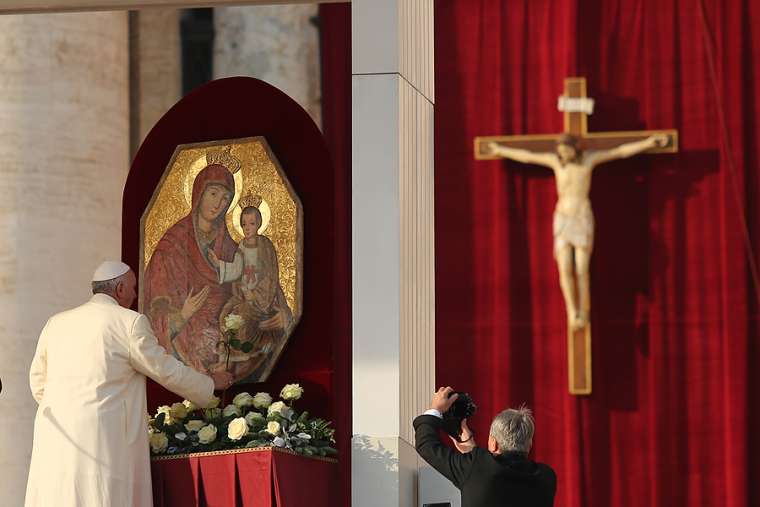
In his other remarks, Francis said the celebration held in St. Peter’s basilica, the passage of the Gospel read and the print of la Morenita that stood tall in front and to the side of the altar made him think of three adjectives for Mary: “woman-Lady-, mother and mestiza [mixed race].”
“Mary introduces herself as a woman,” he said. “And she introduces herself with the message of someone else. Meaning, she’s woman and she’s disciple.”
“Christian piety, throughout the ages, always sought to praise her with new titles,” Francis said. “They were filial titles,” that expressed “the love of the people of God, but they did not touch in any way her being a woman disciple.”
(The word tocar in Spanish, which the pope used speaking off-the-cuff, means to touch, but in several contexts, including this one, also means to change.)
St. Ignatius, Francis said, liked to call the Virgin “Our Lady.” According to the Argentine pontiff, “it is as simple as that. She doesn’t expect anything else. She’s woman, she’s disciple.”
The pope also quoted St. Bernard who said that no praise is enough to talk about Mary, but that in the end, nothing is as representative of her “humble discipleship” more than “being faithful to her master, who is her son, the only redeemer.”
Francis’s words came as he said Mass in Spanish for the thousands who had gathered in St. Peter’s Basilica to mark the feast of Our Lady of Guadalupe, patron of the Americas and the Philippines. This Mass is a tradition he began during the first year of his pontificate.
The pontiff then moved on to the next adjective, that of “mother.” Mary is the mother of all peoples, “to us all,” of “our hearts, of our souls,” and also the mother of the Church. And she’s also a “figure in the Church.”
“We cannot think about the Church without this Marian principle,” he said. “When we look for the role of the woman in the Church, we can go through the path of functionality, because the woman has functions to fulfill in the Church, but that leaves us halfway.”
“Mary woman, Mary mother, without any other essential title,” Francis insisted. Even the litanies, recited at the end of the rosary, are titles given to her by her children who are in love with her and who sing to their mother, but in the end, they don’t change that “essence” of being “Mary, woman and mother.”
The third adjective, the pope said, means Mary becoming “mestiza” to be the mother of everyone. “She became mestiza with humanity. Because she made God mestizo. And this is the great mystery: Mary makes God a mestizo, true God but also true man.”
“Mary is woman, Our Lady; Mary is the mother of her Son and of the Holy hierarchical Church, woman of our peoples but who made God a mestizo.”
 
https://cruxnow.com/vatican/2019/12/pope-calls-idea-of-declaring-mary-co-redemptrix-foolishness/

Saturday, December 7, 2019

Pope: Mariology helps foster dialogue and fraternity among cultures


Image result for mariology


Pope Francis sends a message to the XXIV public session of the Pontifical Academies where the annual Award was presented to Dr. Carme López Calderón and to the Reverend Ionuț-Cătălin Blidar for their commitment to theological research.

By Vatican News
As an introduction to his message, Pope Francis described the Pontifical Academies as places where knowledge becomes service, because - he noted - without knowledge that comes from collaboration and leads to cooperation there is no genuine and integral human development.
An Academy, he said, is a model of synodality and a force for evangelization.
The Pope’s message was addressed to participants in the XXIV Public Session of the seven Pontifical Academies, whose Coordinating Council is presided over by Cardinal Gianfranco Ravasi.
This year’s edition, on the theme “Mary, way to peace among cultures”, was organized by the Pontifical International Marian Academy, which is marking the 60th anniversary of its establishment by Pope Saint John XXIII, on 8 December 1959.

Mary, a teacher of humanity


The Pope reflected on the Marian theme chosen for the edition and reflected briefly on how different popes expressed veneration for Our Lady.
He recalled the dramatic experience of the two world wars that led Pope Pius XII to uphold Mary as a beacon of peace for a frightened humanity.
The Second Vatican Council, he continued, pointed to her as a “teacher of humanity” and a model for the Church in its mission to serve the “deepest aspirations of the human heart”.

Victory of hope over anguish


Pope Saint Paul VI, the Holy Father said, highlighted the bond between the Blessed Virgin and the faithful and said she offers contemporary humanity, oppressed by anguish and loneliness, a serene and reassuring vision: the victory of hope over anguish, of peace over uneasiness.
“She represents the victory of hope over anguish, of communion over loneliness, of peace over upheaval, of joy and beauty over tedium and nausea, of eternal perspectives over temporal ones, of life over death”, he said.

Bringing Mary into the crucial issues of our time


Pope Saint John Paul II, the Pope continued, was firm in his desire that Mariology be acknowledged and upheld in theological formation and in dialogue so it could play its due role in the crucial questions of our time.

Mariology and theology of the Word


Finally, the Pope mentioned the many instances in which Pope Benedict XVI urged scholars to investigate the relationship between Mariology and theology of the Word. In fact, he said, the Pontifical Marian Academy has always accompanied the universal Magisterium of the Church with Mariological input and contribution.
“These commitments are a clear testimony of how Mariology is a necessary presence for dialogue between cultures, and is capable of nourishing fraternity and peace,” he said.
https://www.vaticannews.va/en/pope/news/2019-12/pope-message-public-session-pontifical-academies.html