The Tablet Interview
In an exclusive interview recorded for The Tablet – his first for a UK publication – Pope Francis says that this extraordinary Lent and Eastertide could be a moment of creativity and conversion for the Church, for the world, and for the whole of creation.
• Towards the end of March I suggested to Pope Francis that this might be a good moment to address the English-speaking world: the pandemic that had so affected Italy and Spain was now reaching the United Kingdom, the United States and Australia. Without promising anything, he asked me to send some questions. I picked six themes, each one with a series of questions he could answer or not as he saw fit. A week later, I received a communication that he had recorded some reflections in response to the questions. The interview was conducted in Spanish; the translation is my own.
The first question was about how he was experiencing the pandemic and lockdown, both in the Santa Marta residence and the Vatican administration (“the curia”) more widely, both practically and spiritually.
Pope Francis: The Curia is trying to carry on its work, and to live normally, organising in shifts so that not everyone is present at the same time. It’s been well thought out. We are sticking to the measures ordered by the health authorities. Here in the Santa Marta residence we now have two shifts for meals, which helps a lot to alleviate the impact. Everyone works in his office or from his room, using technology. Everyone is working; there are no idlers here.
How am I living this spiritually? I’m praying more, because I feel I should. And I think of people. That’s what concerns me: people. Thinking of people anoints me, it does me good, it takes me out of my self-preoccupation. Of course I have my areas of selfishness. On Tuesdays, my confessor comes, and I take care of things there.
I’m thinking of my responsibilities now, and what will come afterwards. What will be my service as Bishop of Rome, as head of the Church, in the aftermath? That aftermath has already begun to be revealed as tragic and painful, which is why we must be thinking about it now. The Vatican’s Dicastery for the Promotion of Integral Human Development has been working on this, and meeting with me.
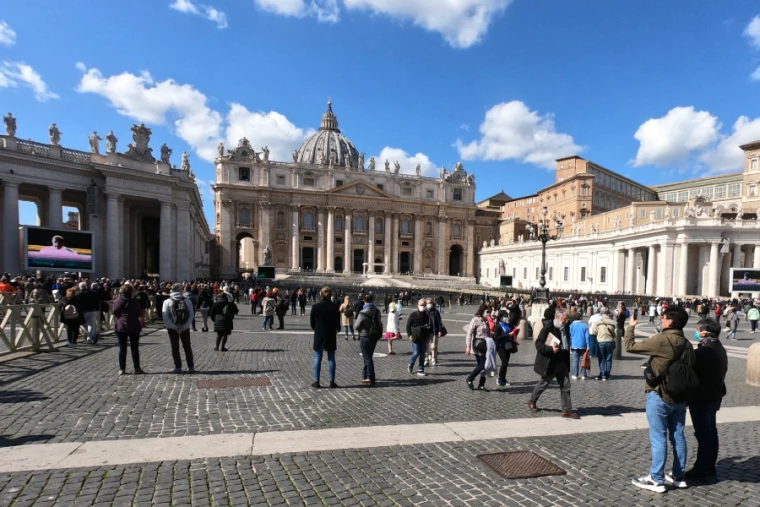
My major concern – at least what comes through my prayer – is how to accompany and be closer to the people of God. Hence the livestreaming of the 7 a.m. Mass [I celebrate each morning] which many people follow and appreciate, as well as the addresses I’ve given, and the 27 March event in St Peter’s Square. Hence, too, the step-up in activities of the office of papal charities, attending to the sick and hungry.
I’m living this as a time of great uncertainty. It’s a time for inventing, for creativity.
In my second question, I referred to a nineteenth-century novel very dear to Pope Francis, which he has mentioned recently: Alessandro Manzoni’s I Promessi Sposi (The Betrothed). The novel’s drama centres on the Milan plague of 1630. There are various priestly characters: the cowardly curé Don Abbondio, the holy cardinal archbishop Borromeo, and the Capuchin friars who serve the lazzaretto, a kind of field hospital where the infected are rigorously separated from the healthy. In the light of the novel, how did Pope Francis see the mission of the Church in the context of Covid-19?
Pope Francis: Cardinal Federigo [Borromeo] really is a hero of the Milan plague. Yet in one of the chapters he goes to greet a village but with the window of his carriage closed to protect himself. This did not go down well with the people. The people of God need their pastor to be close to them, not to over-protect himself. The people of God need their pastors to be self-sacrificing, like the Capuchins, who stayed close.
The creativity of the Christian needs to show forth in opening up new horizons, opening windows, opening transcendence towards God and towards people, and in creating new ways of being at home. It’s not easy to be confined to your house. What comes to my mind is a verse from the Aeneid in the midst of defeat: the counsel is not to give up, but save yourself for better times, for in those times remembering what has happened will help us. Take care of yourselves for a future that will come. And remembering in that future what has happened will do you good.
Take care of the now, for the sake of tomorrow. Always creatively, with a simple creativity, capable of inventing something new each day. Inside the home that’s not hard to discover, but don’t run away, don’t take refuge in escapism, which in this time is of no use to you.
My third question was about government policies in response to the crisis. While the quarantining of the population is a sign that some governments are willing to sacrifice economic wellbeing for the sake of vulnerable people, I suggested it was also exposing levels of exclusion that have been considered normal and acceptable before now.
Pope Francis: It’s true, a number of governments have taken exemplary measures to defend the population on the basis of clear priorities. But we’re realising that all our thinking, like it or not, has been shaped around the economy. In the world of finance it has seemed normal to sacrifice [people], to practise a politics of the throwaway culture, from the beginning to the end of life. I’m thinking, for example, of pre-natal selection. It’s very unusual these days to meet Down’s Syndrome people on the street; when the tomograph [scan] detects them, they are binned. It’s a culture of euthanasia, either legal or covert, in which the elderly are given medication but only up to a point.
What comes to mind is Pope Paul VI’s encyclical Humanae Vitae. The great controversy at the time was over the [contraceptive] pill, but what people didn’t realise was the prophetic force of the encyclical, which foresaw the neo-Malthusianism which was then just getting underway across the world. Paul VI sounded the alarm over that wave of neo-Malthusianism. We see it in the way people are selected according to their utility or productivity: the throwaway culture.
Right now, the homeless continue to be homeless. A photo appeared the other day of a parking lot in Las Vegas where they had been put in quarantine. And the hotels were empty. But the homeless cannot go to a hotel. That is the throwaway culture in practice.
I was curious to know if the Pope saw the crisis and the economic devastation it is wreaking as a chance for an ecological conversion, for reassessing priorities and lifestyles. I asked him concretely whether it was possible that we might see in the future an economy that – to use his words – was more “human” and less “liquid”.
Pope Francis: There is an expression in Spanish: “God always forgives, we forgive sometimes, but nature never forgives.” We did not respond to the partial catastrophes. Who now speaks of the fires in Australia, or remembers that 18 months ago a boat could cross the North Pole because the glaciers had all melted? Who speaks now of the floods? I don’t know if these are the revenge of nature, but they are certainly nature’s responses.
We have a selective memory. I want to dwell on this point. I was amazed at the seventieth anniversary commemoration of the Normandy landings, which was attended by people at the highest levels of culture and politics. It was one big celebration. It’s true that it marked the beginning of the end of dictatorship, but no one seemed to recall the 10,000 boys who remained on that beach.
When I went to Redipuglia for the centenary of the First World War I saw a lovely monument and names on a stone, but that was it. I cried, thinking of Benedict XV’s phrase inutile strage (“senseless massacre”), and the same happened to me at Anzio on All Souls’ Day, thinking of all the North American soldiers buried there, each of whom had a family, and how any of them might have been me.
At this time in Europe when we are beginning to hear populist speeches and witness political decisions of this selective kind it’s all too easy to remember Hitler’s speeches in 1933, which were not so different from some of the speeches of a few European politicians now.What comes to mind is another verse of Virgil’s: [forsan et haec olim] meminisse iubavit["perhaps one day it will be good to remember these things too”]. We need to recover our memory because memory will come to our aid. This is not humanity’s first plague; the others have become mere anecdotes. We need to remember our roots, our tradition which is packed full of memories. In the Spiritual Exercises of St Ignatius, the First Week, as well as the “Contemplation to Attain Love” in the Fourth Week, are completely taken up with remembering. It’s a conversion through remembrance.
This crisis is affecting us all, rich and poor alike, and putting a spotlight on hypocrisy. I am worried by the hypocrisy of certain political personalities who speak of facing up to the crisis, of the problem of hunger in the world, but who in the meantime manufacture weapons. This is a time to be converted from this kind of functional hypocrisy. It’s a time for integrity. Either we are coherent with our beliefs or we lose everything.
You ask me about conversion. Every crisis contains both danger and opportunity: the opportunity to move out from the danger. Today I believe we have to slow down our rate of production and consumption (Laudato Si’, 191) and to learn to understand and contemplate the natural world. We need to reconnect with our real surroundings. This is the opportunity for conversion.
Yes, I see early signs of an economy that is less liquid, more human. But let us not lose our memory once all this is past, let us not file it away and go back to where we were. This is the time to take the decisive step, to move from using and misusing nature to contemplating it. We have lost the contemplative dimension; we have to get it back at this time.
And speaking of contemplation, I’d like to dwell on one point. This is the moment to see the poor. Jesus says we will have the poor with us always, and it’s true. They are a reality we cannot deny. But the poor are hidden, because poverty is bashful. In Rome recently, in the midst of the quarantine, a policeman said to a man: “You can’t be on the street, go home.” The response was: “I have no home. I live in the street.” To discover such a large number of people who are on the margins … And we don’t see them, because poverty is bashful. They are there but we don’t see them: they have become part of the landscape; they are things.
St Teresa of Calcutta saw them, and had the courage to embark on a journey of conversion. To “see” the poor means to restore their humanity. They are not things, not garbage; they are people. We can’t settle for a welfare policy such as we have for rescued animals. We often treat the poor like rescued animals. We can’t settle for a partial welfare policy.
I’m going to dare to offer some advice. This is the time to go to the underground. I’m thinking of Dostoyevsky’s short novel, Notes from the Underground. The employees of that prison hospital had become so inured they treated their poor prisoners like things. And seeing the way they treated one who had just died, the one on the bed alongside tells them: “Enough! He too had a mother!” We need to tell ourselves this often: that poor person had a mother who raised him lovingly. Later in life we don’t know what happened. But it helps to think of that love he once received through his mother’s hope.
We disempower the poor. We don’t give them the right to dream of their mothers. They don’t know what affection is; many live on drugs. And to see them can help us to discover the piety, the pietas, which points towards God and towards our neighbour.
Go down into the underground, and pass from the hyper-virtual, fleshless world to the suffering flesh of the poor. This is the conversion we have to undergo. And if we don’t start there, there will be no conversion.
I’m thinking at this time of the saints who live next door. They are heroes: doctors, volunteers, religious sisters, priests, shop workers – all performing their duty so that society can continue functioning. How many doctors and nurses have died! How many religious sisters have died! All serving … What comes to my mind is something said by the tailor, in my view one of the characters with greatest integrity in The Betrothed. He says: “The Lord does not leave his miracles half-finished.” If we become aware of this miracle of the next-door saints, if we can follow their tracks, the miracle will end well, for the good of all. God doesn’t leave things halfway. We are the ones who do that.
What we are living now is a place of metanoia (conversion), and we have the chance to begin. So let’s not let it slip from us, and let’s move ahead.
My fifth question centred on the effects on the Church of the crisis, and the need to rethink our ways of operating. Does he see emerging from this a Church that is more missionary, more creative, less attached to institutions? Are we seeing a new kind of “home Church”?
Pope Francis: Less attached to institutions? I’d say less attached to certain ways of thinking. Because the Church is institution. The temptation is to dream of a de-institutionalised Church, a gnostic Church without institutions, or one that is subject to fixed institutions, which would be a Pelagian Church. The one who makes the Church is the Holy Spirit, who is neither gnostic nor Pelagian. It is the Holy Spirit who institutionalises the Church, in an alternative, complementary way, because the Holy Spirit provokes disorder through the charisms, but then out of that disorder creates harmony.
A Church that is free is not an anarchic Church, because freedom is God’s gift. An institutional Church means a Church institutionalised by the Holy Spirit.
A tension between disorder and harmony: this is the Church that must come out of the crisis. We have to learn to live in a Church that exists in the tension between harmony and disorder provoked by the Holy Spirit. If you ask me which book of theology can best help you understand this, it would be the Acts of the Apostles. There you will see how the Holy Spirit de-institutionalises what is no longer of use, and institutionalises the future of the Church. That is the Church that needs to come out of the crisis.
About a week ago an Italian bishop, somewhat flustered, called me. He had been going round the hospitals wanting to give absolution to those inside the wards from the hallway of the hospital. But he had spoken to canon lawyers who had told him he couldn’t, that absolution could only be given in direct contact. “What do you think, Father?” he had asked me. I told him: “Bishop, fulfil your priestly duty.” And the bishop said Grazie, ho capito (“Thank you, I understand”). I found out later that he was giving absolution all around the place.
This is the freedom of the Spirit in the midst of a crisis, not a Church closed off in institutions. That doesn’t mean that canon law is not important: it is, it helps, and please let’s make good use of it, it is for our good. But the final canon says that the whole of canon law is for the salvation of souls, and that’s what opens the door for us to go out in times of difficulty to bring the consolation of God.
You ask me about a “home Church”. We have to respond to our confinement with all our creativity. We can either get depressed and alienated – through media that can take us out of our reality – or we can get creative. At home we need an apostolic creativity, a creativity shorn of so many useless things, but with a yearning to express our faith in community, as the people of God. So: to be in lockdown, but yearning, with that memory that yearns and begets hope – this is what will help us escape our confinement.
Finally, I asked Pope Francis how we are being called to live this extraordinary Lent and Eastertide. I asked him if he had a particular message for the elderly who were self-isolating, for confined young people, and for those facing poverty as result of the crisis.
Pope Francis: You speak of the isolated elderly: solitude and distance. How many elderly there are whose children do not go and visit them in normal times! I remember in Buenos Aires when I visited old people’s homes, I would ask them: And how’s your family? Fine, fine! Do they come? Yes, always! Then the nurse would take me aside and say the children hadn’t been to see them in six months. Solitude and abandonment … distance.
Yet the elderly continue to be our roots. And they must speak to the young. This tension between young and old must always be resolved in the encounter with each other. Because the young person is bud and foliage, but without roots they cannot bear fruit. The elderly are the roots. I would say to them, today: I know you feel death is close, and you are afraid, but look elsewhere, remember your children, and do not stop dreaming. This is what God asks of you: to dream (Joel 3:1).
What would I say to the young people? Have the courage to look ahead, and to be prophetic. May the dreams of the old correspond to your prophecies – also Joel 3:1.
Those who have been impoverished by the crisis are today’s deprived, who are added to the numbers of deprived of all times, men and women whose status is “deprived”. They have lost everything, or they are going to lose everything. What meaning does deprivation have for me, in the light of the Gospel? It means to enter into the world of the deprived, to understand that he who had, no longer has. What I ask of people is that they take the elderly and the young under their wing, that they take history under the wing, take the deprived under their wing.
What comes now to mind is another verse of Virgil’s, at the end of Book 2 of the Aeneid, when Aeneas, following defeat in Troy, has lost everything. Two paths lie before him: to remain there to weep and end his life, or to follow what was in his heart, to go up to the mountain and leave the war behind. It’s a beautiful verse. Cessi, et sublato montem genitore petivi (“I gave way to fate and, bearing my father on my shoulders, made for the mountain”).
This is what we all have to do now, today: to take with us the roots of our traditions, and make for the mountain.
Austen Ivereigh is a fellow in contemporary church history at Campion Hall, at the University of Oxford. His latest book is Wounded Shepherd: Pope Francis’s Struggle to Convert the Catholic Church, published by Henry Holt.
• Towards the end of March I suggested to Pope Francis that this might be a good moment to address the English-speaking world: the pandemic that had so affected Italy and Spain was now reaching the United Kingdom, the United States and Australia. Without promising anything, he asked me to send some questions. I picked six themes, each one with a series of questions he could answer or not as he saw fit. A week later, I received a communication that he had recorded some reflections in response to the questions. The interview was conducted in Spanish; the translation is my own.
The first question was about how he was experiencing the pandemic and lockdown, both in the Santa Marta residence and the Vatican administration (“the curia”) more widely, both practically and spiritually.
Pope Francis: The Curia is trying to carry on its work, and to live normally, organising in shifts so that not everyone is present at the same time. It’s been well thought out. We are sticking to the measures ordered by the health authorities. Here in the Santa Marta residence we now have two shifts for meals, which helps a lot to alleviate the impact. Everyone works in his office or from his room, using technology. Everyone is working; there are no idlers here.
How am I living this spiritually? I’m praying more, because I feel I should. And I think of people. That’s what concerns me: people. Thinking of people anoints me, it does me good, it takes me out of my self-preoccupation. Of course I have my areas of selfishness. On Tuesdays, my confessor comes, and I take care of things there.
I’m thinking of my responsibilities now, and what will come afterwards. What will be my service as Bishop of Rome, as head of the Church, in the aftermath? That aftermath has already begun to be revealed as tragic and painful, which is why we must be thinking about it now. The Vatican’s Dicastery for the Promotion of Integral Human Development has been working on this, and meeting with me.
My major concern – at least what comes through my prayer – is how to accompany and be closer to the people of God. Hence the livestreaming of the 7 a.m. Mass [I celebrate each morning] which many people follow and appreciate, as well as the addresses I’ve given, and the 27 March event in St Peter’s Square. Hence, too, the step-up in activities of the office of papal charities, attending to the sick and hungry.
I’m living this as a time of great uncertainty. It’s a time for inventing, for creativity.
In my second question, I referred to a nineteenth-century novel very dear to Pope Francis, which he has mentioned recently: Alessandro Manzoni’s I Promessi Sposi (The Betrothed). The novel’s drama centres on the Milan plague of 1630. There are various priestly characters: the cowardly curé Don Abbondio, the holy cardinal archbishop Borromeo, and the Capuchin friars who serve the lazzaretto, a kind of field hospital where the infected are rigorously separated from the healthy. In the light of the novel, how did Pope Francis see the mission of the Church in the context of Covid-19?
Pope Francis: Cardinal Federigo [Borromeo] really is a hero of the Milan plague. Yet in one of the chapters he goes to greet a village but with the window of his carriage closed to protect himself. This did not go down well with the people. The people of God need their pastor to be close to them, not to over-protect himself. The people of God need their pastors to be self-sacrificing, like the Capuchins, who stayed close.
The creativity of the Christian needs to show forth in opening up new horizons, opening windows, opening transcendence towards God and towards people, and in creating new ways of being at home. It’s not easy to be confined to your house. What comes to my mind is a verse from the Aeneid in the midst of defeat: the counsel is not to give up, but save yourself for better times, for in those times remembering what has happened will help us. Take care of yourselves for a future that will come. And remembering in that future what has happened will do you good.
Take care of the now, for the sake of tomorrow. Always creatively, with a simple creativity, capable of inventing something new each day. Inside the home that’s not hard to discover, but don’t run away, don’t take refuge in escapism, which in this time is of no use to you.
My third question was about government policies in response to the crisis. While the quarantining of the population is a sign that some governments are willing to sacrifice economic wellbeing for the sake of vulnerable people, I suggested it was also exposing levels of exclusion that have been considered normal and acceptable before now.
Pope Francis: It’s true, a number of governments have taken exemplary measures to defend the population on the basis of clear priorities. But we’re realising that all our thinking, like it or not, has been shaped around the economy. In the world of finance it has seemed normal to sacrifice [people], to practise a politics of the throwaway culture, from the beginning to the end of life. I’m thinking, for example, of pre-natal selection. It’s very unusual these days to meet Down’s Syndrome people on the street; when the tomograph [scan] detects them, they are binned. It’s a culture of euthanasia, either legal or covert, in which the elderly are given medication but only up to a point.
What comes to mind is Pope Paul VI’s encyclical Humanae Vitae. The great controversy at the time was over the [contraceptive] pill, but what people didn’t realise was the prophetic force of the encyclical, which foresaw the neo-Malthusianism which was then just getting underway across the world. Paul VI sounded the alarm over that wave of neo-Malthusianism. We see it in the way people are selected according to their utility or productivity: the throwaway culture.
Right now, the homeless continue to be homeless. A photo appeared the other day of a parking lot in Las Vegas where they had been put in quarantine. And the hotels were empty. But the homeless cannot go to a hotel. That is the throwaway culture in practice.
I was curious to know if the Pope saw the crisis and the economic devastation it is wreaking as a chance for an ecological conversion, for reassessing priorities and lifestyles. I asked him concretely whether it was possible that we might see in the future an economy that – to use his words – was more “human” and less “liquid”.
Pope Francis: There is an expression in Spanish: “God always forgives, we forgive sometimes, but nature never forgives.” We did not respond to the partial catastrophes. Who now speaks of the fires in Australia, or remembers that 18 months ago a boat could cross the North Pole because the glaciers had all melted? Who speaks now of the floods? I don’t know if these are the revenge of nature, but they are certainly nature’s responses.
We have a selective memory. I want to dwell on this point. I was amazed at the seventieth anniversary commemoration of the Normandy landings, which was attended by people at the highest levels of culture and politics. It was one big celebration. It’s true that it marked the beginning of the end of dictatorship, but no one seemed to recall the 10,000 boys who remained on that beach.
When I went to Redipuglia for the centenary of the First World War I saw a lovely monument and names on a stone, but that was it. I cried, thinking of Benedict XV’s phrase inutile strage (“senseless massacre”), and the same happened to me at Anzio on All Souls’ Day, thinking of all the North American soldiers buried there, each of whom had a family, and how any of them might have been me.
At this time in Europe when we are beginning to hear populist speeches and witness political decisions of this selective kind it’s all too easy to remember Hitler’s speeches in 1933, which were not so different from some of the speeches of a few European politicians now.What comes to mind is another verse of Virgil’s: [forsan et haec olim] meminisse iubavit["perhaps one day it will be good to remember these things too”]. We need to recover our memory because memory will come to our aid. This is not humanity’s first plague; the others have become mere anecdotes. We need to remember our roots, our tradition which is packed full of memories. In the Spiritual Exercises of St Ignatius, the First Week, as well as the “Contemplation to Attain Love” in the Fourth Week, are completely taken up with remembering. It’s a conversion through remembrance.
This crisis is affecting us all, rich and poor alike, and putting a spotlight on hypocrisy. I am worried by the hypocrisy of certain political personalities who speak of facing up to the crisis, of the problem of hunger in the world, but who in the meantime manufacture weapons. This is a time to be converted from this kind of functional hypocrisy. It’s a time for integrity. Either we are coherent with our beliefs or we lose everything.
You ask me about conversion. Every crisis contains both danger and opportunity: the opportunity to move out from the danger. Today I believe we have to slow down our rate of production and consumption (Laudato Si’, 191) and to learn to understand and contemplate the natural world. We need to reconnect with our real surroundings. This is the opportunity for conversion.
Yes, I see early signs of an economy that is less liquid, more human. But let us not lose our memory once all this is past, let us not file it away and go back to where we were. This is the time to take the decisive step, to move from using and misusing nature to contemplating it. We have lost the contemplative dimension; we have to get it back at this time.
And speaking of contemplation, I’d like to dwell on one point. This is the moment to see the poor. Jesus says we will have the poor with us always, and it’s true. They are a reality we cannot deny. But the poor are hidden, because poverty is bashful. In Rome recently, in the midst of the quarantine, a policeman said to a man: “You can’t be on the street, go home.” The response was: “I have no home. I live in the street.” To discover such a large number of people who are on the margins … And we don’t see them, because poverty is bashful. They are there but we don’t see them: they have become part of the landscape; they are things.
St Teresa of Calcutta saw them, and had the courage to embark on a journey of conversion. To “see” the poor means to restore their humanity. They are not things, not garbage; they are people. We can’t settle for a welfare policy such as we have for rescued animals. We often treat the poor like rescued animals. We can’t settle for a partial welfare policy.
I’m going to dare to offer some advice. This is the time to go to the underground. I’m thinking of Dostoyevsky’s short novel, Notes from the Underground. The employees of that prison hospital had become so inured they treated their poor prisoners like things. And seeing the way they treated one who had just died, the one on the bed alongside tells them: “Enough! He too had a mother!” We need to tell ourselves this often: that poor person had a mother who raised him lovingly. Later in life we don’t know what happened. But it helps to think of that love he once received through his mother’s hope.
We disempower the poor. We don’t give them the right to dream of their mothers. They don’t know what affection is; many live on drugs. And to see them can help us to discover the piety, the pietas, which points towards God and towards our neighbour.
Go down into the underground, and pass from the hyper-virtual, fleshless world to the suffering flesh of the poor. This is the conversion we have to undergo. And if we don’t start there, there will be no conversion.
I’m thinking at this time of the saints who live next door. They are heroes: doctors, volunteers, religious sisters, priests, shop workers – all performing their duty so that society can continue functioning. How many doctors and nurses have died! How many religious sisters have died! All serving … What comes to my mind is something said by the tailor, in my view one of the characters with greatest integrity in The Betrothed. He says: “The Lord does not leave his miracles half-finished.” If we become aware of this miracle of the next-door saints, if we can follow their tracks, the miracle will end well, for the good of all. God doesn’t leave things halfway. We are the ones who do that.
What we are living now is a place of metanoia (conversion), and we have the chance to begin. So let’s not let it slip from us, and let’s move ahead.
My fifth question centred on the effects on the Church of the crisis, and the need to rethink our ways of operating. Does he see emerging from this a Church that is more missionary, more creative, less attached to institutions? Are we seeing a new kind of “home Church”?
Pope Francis: Less attached to institutions? I’d say less attached to certain ways of thinking. Because the Church is institution. The temptation is to dream of a de-institutionalised Church, a gnostic Church without institutions, or one that is subject to fixed institutions, which would be a Pelagian Church. The one who makes the Church is the Holy Spirit, who is neither gnostic nor Pelagian. It is the Holy Spirit who institutionalises the Church, in an alternative, complementary way, because the Holy Spirit provokes disorder through the charisms, but then out of that disorder creates harmony.
A Church that is free is not an anarchic Church, because freedom is God’s gift. An institutional Church means a Church institutionalised by the Holy Spirit.
A tension between disorder and harmony: this is the Church that must come out of the crisis. We have to learn to live in a Church that exists in the tension between harmony and disorder provoked by the Holy Spirit. If you ask me which book of theology can best help you understand this, it would be the Acts of the Apostles. There you will see how the Holy Spirit de-institutionalises what is no longer of use, and institutionalises the future of the Church. That is the Church that needs to come out of the crisis.
About a week ago an Italian bishop, somewhat flustered, called me. He had been going round the hospitals wanting to give absolution to those inside the wards from the hallway of the hospital. But he had spoken to canon lawyers who had told him he couldn’t, that absolution could only be given in direct contact. “What do you think, Father?” he had asked me. I told him: “Bishop, fulfil your priestly duty.” And the bishop said Grazie, ho capito (“Thank you, I understand”). I found out later that he was giving absolution all around the place.
This is the freedom of the Spirit in the midst of a crisis, not a Church closed off in institutions. That doesn’t mean that canon law is not important: it is, it helps, and please let’s make good use of it, it is for our good. But the final canon says that the whole of canon law is for the salvation of souls, and that’s what opens the door for us to go out in times of difficulty to bring the consolation of God.
You ask me about a “home Church”. We have to respond to our confinement with all our creativity. We can either get depressed and alienated – through media that can take us out of our reality – or we can get creative. At home we need an apostolic creativity, a creativity shorn of so many useless things, but with a yearning to express our faith in community, as the people of God. So: to be in lockdown, but yearning, with that memory that yearns and begets hope – this is what will help us escape our confinement.
Finally, I asked Pope Francis how we are being called to live this extraordinary Lent and Eastertide. I asked him if he had a particular message for the elderly who were self-isolating, for confined young people, and for those facing poverty as result of the crisis.
Pope Francis: You speak of the isolated elderly: solitude and distance. How many elderly there are whose children do not go and visit them in normal times! I remember in Buenos Aires when I visited old people’s homes, I would ask them: And how’s your family? Fine, fine! Do they come? Yes, always! Then the nurse would take me aside and say the children hadn’t been to see them in six months. Solitude and abandonment … distance.
Yet the elderly continue to be our roots. And they must speak to the young. This tension between young and old must always be resolved in the encounter with each other. Because the young person is bud and foliage, but without roots they cannot bear fruit. The elderly are the roots. I would say to them, today: I know you feel death is close, and you are afraid, but look elsewhere, remember your children, and do not stop dreaming. This is what God asks of you: to dream (Joel 3:1).
What would I say to the young people? Have the courage to look ahead, and to be prophetic. May the dreams of the old correspond to your prophecies – also Joel 3:1.
Those who have been impoverished by the crisis are today’s deprived, who are added to the numbers of deprived of all times, men and women whose status is “deprived”. They have lost everything, or they are going to lose everything. What meaning does deprivation have for me, in the light of the Gospel? It means to enter into the world of the deprived, to understand that he who had, no longer has. What I ask of people is that they take the elderly and the young under their wing, that they take history under the wing, take the deprived under their wing.
What comes now to mind is another verse of Virgil’s, at the end of Book 2 of the Aeneid, when Aeneas, following defeat in Troy, has lost everything. Two paths lie before him: to remain there to weep and end his life, or to follow what was in his heart, to go up to the mountain and leave the war behind. It’s a beautiful verse. Cessi, et sublato montem genitore petivi (“I gave way to fate and, bearing my father on my shoulders, made for the mountain”).
This is what we all have to do now, today: to take with us the roots of our traditions, and make for the mountain.
Austen Ivereigh is a fellow in contemporary church history at Campion Hall, at the University of Oxford. His latest book is Wounded Shepherd: Pope Francis’s Struggle to Convert the Catholic Church, published by Henry Holt.
https://www.thetablet.co.uk/features/2/17845/pope-francis-says-pandemic-can-be-a-place-of-conversion-