Friday, April 3, 2020

Pope encourages Catholics to contemplate ‘seven sorrows’ of Mary

Pope encourages Catholics to contemplate ‘seven sorrows’ of Mary


Cindy Wooden
Apr 3, 2020


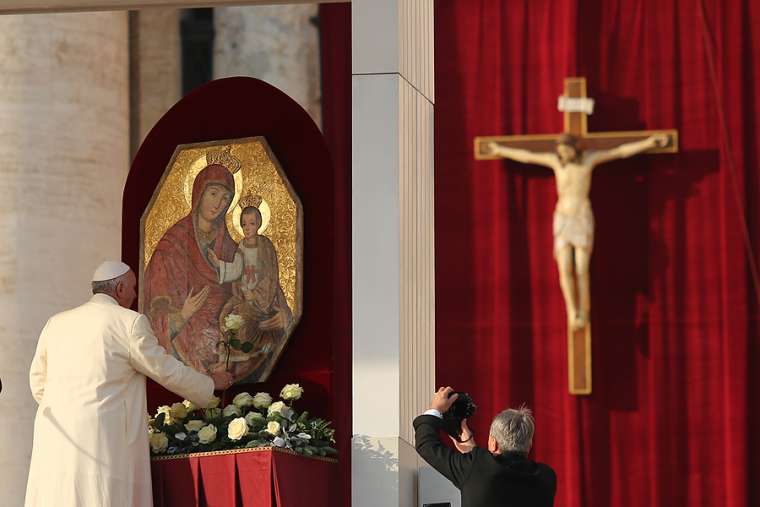
ROME - On the Friday before Holy Week, Pope Francis asked people to keep a long tradition of Catholic piety by focusing on “the suffering and sorrows of Our Lady.”
“Honor Our Lady and say, ‘This is my mother,’ because she is mother. This is the title that she received from Jesus precisely there, at the cross,” the pope said at Mass April 3. Jesus “did not make her prime minister or give her ‘functional’ titles. Only ‘mother.'”
Mary did not ask for any honor or special titles, the pope said. “She didn’t ask to be a quasi-redemptrix or a co-redemptrix, no. There is only one redeemer and this title cannot be duplicated.”
For decades, some Catholics have been petitioning the popes to recognize Mary as “co-redemptrix” to highlight the essential role she played in redemption.
“Just disciple and mother - and in that way, as mother, we must think about her, seek her out, pray to her,” Pope Francis said. “She is the mother in the church that is mother. In the maternity of Our Lady, we see the maternity of the church, which receives everyone, good and bad, everyone.”
The Friday before Palm Sunday is observed in many places as the “Friday of Sorrows,” a special day of Marian devotion.
Pope Francis asked Catholics to spend time considering the “seven sorrows” of Mary: Simeon’s prophecy that a sword would pierce her heart; the flight into Egypt; the worry when the child Jesus could not be found because he was in the temple; meeting Jesus on the way to Calvary; seeing Jesus on the cross; witnessing Jesus, lifeless, being taken down from the cross; and seeing Jesus being buried in the tomb.
Mary bore those sufferings “with strength, with tears - it wasn’t a fake cry, hers was truly a heart destroyed by pain,” the pope said.
Pope Francis said that late in the evening, when he prays the Angelus prayer, he contemplates the seven sorrows and recalls “how the mother of the church, with so much pain, gave birth to all of us.”
With the morning Masses from the chapel of the Domus Sanctae Marthae livestreamed during the coronavirus crisis, Pope Francis begins the liturgy with a special thought and prayer intention each day.
“There are people who already are thinking about the ‘after,’ what happens after the pandemic,” the pope said April 3. They already are strategizing ways to alleviate “all the problems that will come - problems of poverty, jobs, hunger. Let us pray for all the people who are helping today, but also thinking of tomorrow to help all of us.”

Thursday, April 2, 2020

Vatican Grants Emergency Plenary Indulgence for Divine Mercy Chaplet

By Chris Sparks
The Church is responding to the problems we all face as a result of this pandemic with great seriousness and generosity. The Holy Father is throwing wide open the doors of the Church’s storehouses of grace for the faithful, making it as easy as possible for all of us to be assured of the graces we need to speed the sick and the dying through Purgatory, and to be assured of the graces needed for salvation at the moment of our deaths.
Spread the news of these special graces to every Catholic on the front lines of facing this disease that you know. Make sure they know how to make use of these graces.
New Plenary Indulgence
Because of the pandemic, anyone who, with “the will to fulfil the usual conditions (sacramental confession, Eucharistic communion and prayer according to the Holy Father's intentions), as soon as possible,” recites the Divine Mercy Chaplet with the intention “to implore from Almighty God the end of the epidemic, relief for those who are afflicted and eternal salvation for those whom the Lord has called to Himself,” can receive a plenary indulgence each day.
This great news was announced in an official decree from the Apostolic Penitentiary on March 20, 2020.
There are other ways to gain this special plenary indulgence, as well:
  • the faithful suffering from coronavirus and subject to quarantine by order of the health authority in hospitals or in their own homes, with a spirit detached from any sin, can gain the plenary indulgence if they “unite spiritually through the media to the celebration of Holy Mass, the recitation of the Holy Rosary, to the pious practice of the Way of the Cross or other forms of devotion, or if at least they will recite the Creed, the Lord’s Prayer and a pious invocation to the Blessed Virgin Mary, offering this trial in a spirit of faith in God and charity towards their brothers and sisters, with the will to fulfil the usual conditions (sacramental confession, Eucharistic communion and prayer according to the Holy Father’s intentions), as soon as possible.
  • “Health care workers, family members and all those who, following the example of the Good Samaritan, exposing themselves to the risk of contagion, care for the sick of Coronavirus according to the words of the divine Redeemer: “Greater love has no one than this: to lay down one’s life for one’s friends” (Jn 15: 13), will obtain the same gift of the Plenary Indulgence under the same conditions.”
  • “This Apostolic Penitentiary also willingly grants a Plenary Indulgence under the same conditions on the occasion of the current world epidemic, also to those faithful who offer a visit to the Blessed Sacrament, or Eucharistic adoration, or reading the Holy Scriptures for at least half an hour, or the recitation of the Holy Rosary, or the pious exercise of the Way of the Cross, or the recitation of the Chaplet of Divine Mercy, to implore from Almighty God the end of the epidemic, relief for those who are afflicted and eternal salvation for those whom the Lord has called to Himself.”
And here’s a crucial concession to us all, in case we can’t receive the Anointing of the Sick during this period of pandemic and quarantine:
  • “The Church prays for those who find themselves unable to receive the Sacrament of the Anointing of the Sick and of the Viaticum, entrusting each and every one to divine Mercy by virtue of the communion of saints and granting the faithful a Plenary Indulgence on the point of death, provided that they are duly disposed and have recited a few prayers during their lifetime (in this case the Church makes up for the three usual conditions required). For the attainment of this indulgence the use of the crucifix or the cross is recommended (cf. Enchiridion indulgentiarum, no.12).”
Divine Mercy graces and promises
And more: Make sure they know of the special graces promised to us by our Lord through St. Faustina. Make sure people know that we can obtain unimaginable graces for ourselves, for those suffering as a result of this coronavirus, and for the whole world as we groan beneath the burden of this pandemic.
Jesus told St. Faustina of a number of ways to help people make sure that their final destination is Heaven.
Jesus made extraordinary promises for praying the Divine Mercy Chaplet:
At the hour of their death, I defend as My own glory every soul that will say this chaplet; or when others say it for a dying person, the pardon is the same. When this chaplet is said by the bedside of a dying person, God’s anger is placated, unfathomable mercy envelops the soul, and the very depths of My tender mercy are moved for the sake of the sorrowful Passion of My Son (Diary of Saint Maria Faustina Kowalska, 811).
… when they say this chaplet in the presence of the dying, I will stand between My Father and the dying person, not as the just Judge but as the merciful Savior (Diary, 1541).
He also made extraordinary promises for veneration of the Divine Mercy Image:
Paint an image according to the pattern you see, with the signature: Jesus, I trust in You. I promise that the soul that will venerate this image will not perish. I also promise victory over [its] enemies already here on earth, especially at the hour of death. I Myself will defend it as My own glory (Diary, 47 and 48).
Jesus made extraordinary promises for those who trust in Him.
The graces of My mercy are drawn by means of one vessel only, and that is — trust. The more a soul trusts, the more it will receive (Diary, 1578).
My daughter, know that My Heart is mercy itself. From this sea of mercy, graces flow out upon the whole world. No soul that has approached Me has ever gone away unconsoled. All misery gets buried in the depths of My mercy, and every saving and sanctifying grace flows from this fountain. My daughter, I desire that your heart be an abiding place of My mercy. I desire that this mercy flow out upon the whole world through your heart. Let no one who approaches you go away without that trust in My mercy which I so ardently desire for souls.
Pray as much as you can for the dying. By your entreaties, obtain for them trust in My mercy, because they have most need of trust, and have it the least. Be assured that the grace of eternal salvation for certain souls in their final moment depends on your prayer. 
You know the whole abyss of My mercy, so draw upon it for yourself and especially for poor sinners. Sooner would heaven and earth turn into nothingness than would My mercy not embrace a trusting soul (Diary, 1777).
Jesus also made extraordinary promises to all those who spread the message and devotion of Divine Mercy:
Souls who spread the honor of My mercy I shield through their entire lives as a tender mother her infant, and at the hour of death I will not be a Judge for them, but the Merciful Savior. At that last hour, a soul has nothing with which to defend itself except My mercy. Happy is the soul that during its lifetime immersed itself in the Fountain of Mercy, because justice will have no hold on it (Diary, 1075).
Turn to Our Lady
So during this pandemic, let’s thank God for the tremendous graces He’s made available to us through the Holy Father and through St. Faustina. Let’s make sure we spread the word of God’s merciful love, and make regular use of the devotions He’s given to us with such exceptional promises. And let us join the Holy See in asking the Blessed Mother for her special help now:
May the Blessed Virgin Mary, Mother of God and of the Church, Health of the Sick and Help of Christians, our Advocate, help suffering humanity, saving us from the evil of this pandemic and obtaining for us every good necessary for our salvation and sanctification.
Pray for me; I’ll pray for you.
Chris Sparks serves as senior book editor for the Marian Fathers. He is the author of the Marian Press book How Can You Still Be Catholic? 50 Answers to a Good Question.

Friday, March 20, 2020

Pope at Mass: “Let’s return to our Father”


Once again the Pope prays for healthcare providers in the hard hit Bergamo region of Italy during his Mass at the Casa Santa Marta on Friday, and urges us to “return to our Father who is waiting for us”. (With link to playback of live broadcast)
By Vatican News
“Yesterday, I received a message from a priest from the Bergamo region who asked for prayers for the doctors working there…. They are at the end their strength…and are truly giving their lives to help those who are ill, to save others’ lives.” He also prayed for civil leaders who are managing the crisis and often “suffer from being misunderstood”. “They are the pillars helping us move out of the situation and are defending us from this crisis”, the Pope added. “So, let’s pray for them”.

Song from his childhood

The Pope introduced his homily saying the words “return to the Lord, your God, from the first reading from Hosea (14:2), always remind him of a song sung by Carlo Buti 75 years ago.
"The Italian families in Buenos Aires used to listen to it. They liked it a lot. ‘Return to your daddy, he will still sing you a lullaby’. Return. But it’s your Father who tells you to return. God is your Daddy. He’s not a judge. He’s your Daddy. Go back home."


Listen to "Torna Piccina Mia", the song Pope Francis refers to

Father waits for His wayward son

That memory then lead him to the 15th chapter of Luke. There, another Father waits for his son who left home taking “all that money and wasting it”.
"If he sees him from a distance, it’s because He was waiting for him. How many times He went up the terrace day after day, month after months, perhaps years even. He waited for His son."

The Father’s tenderness

This is how God’s shows His tenderness. “It speaks to us especially during Lent”, the Pope said.
"[Lent] is the time to enter into ourselves and to remember the Father and return to our Daddy. ‘But, Father, I’m ashamed to go back because, you know, Father I've …done so many things wrong’. What will the Lord say? ‘Return. I will heal their defection. I will love them freely; for my wrath is turned away from them (Hosea 14:4).’ Return to your Father. The God of tenderness will heal us.”
This Father will heal us of  “so many of life’s wounds”, the Pope explained.
“Going back to God is going back to an embrace, the Father’s embrace, It’s not going to God. No, it’s going back home.”
Listen to our report

Confession when a priest is not available

This habit of returning home “takes flesh in the Sacrament of Reconciliation”, the Pope explained.
“I know that many of you go to confession before Easter… Many will say to me: ‘But Father…I can't leave the house and I want to make my peace with the Lord. I want Him to embrace me… How can I do that unless I find a priest?’. Do what the catechism says. It's very clear. If you don't find a priest to go to confession, speak to God. He's your Father. Tell Him the truth: ‘Lord. I did this and this and this. Pardon me.’ Ask His forgiveness with all your heart with an act of contrition, and promise Him, ‘afterward I will go to confession.’ You will return to God's grace immediately. You yourself can draw near, as the catechism teaches us, to God's forgiveness,s without having a priest at hand.”

Return

At the end of his homily, the Pope expressed the hope that the word “return” might “echo in our ears today”.
“Return to your Daddy. Return to your Father. He’s waiting for you, and He will throw a feast for you.” 


Live broadcast, Mass, Casa Santa

Thursday, March 19, 2020

Papal devotion: Especially in times of trial, pope turns to St. Joseph


Cindy Wooden
Mar 19, 2020


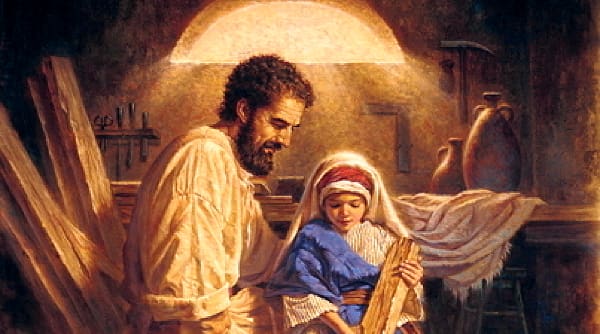
ROME - St. Joseph is the patron saint of retired Pope Benedict XVI - Joseph Ratzinger - but Pope Francis’ devotion to the husband of Mary and guardian of Jesus is clear as well.
In fact, at the beginning of his pontificate in 2013, Pope Francis confirmed a directive that Pope Benedict had made, but which had not gone into effect, to include the name of St. Joseph permanently in the Eucharistic prayers used at most Masses in the Latin rite.
Pope Francis formally inaugurated his papacy on St. Joseph’s feast day, March 19, and he has a spikenard, the flower used as a symbol of St. Joseph, on his coat-of-arms.
And he has popularized statues of St. Joseph sleeping - or, better, dreaming - mentioning on many occasions how he places particularly difficult prayer requests under the statue.
Meeting families in the Philippines in January 2015, he told them, “I have great love for St. Joseph because he is a man of silence and strength. On my table I have an image of St. Joseph sleeping. Even when he is asleep, he is taking care of the church.”
The thing is, he said, sleep and dreams are very important in the few mentions of St. Joseph in the Gospel. An angel comes to him in a dream to tell him not to be afraid to take Mary as his wife; later, an angel comes to him in a dream to tell him to flee to Egypt with Mary and the baby Jesus, because Herod wants to kill the child.
The Italian website Vatican Insider reported that Pope Francis had told one of his aides about the statue early on. “You know,” he reportedly said, “you have to be patient with these carpenters: They tell you they’ll have a piece of furniture finished in a couple of weeks and it ends up taking a month even. But they get the job done and they do it well! You just need to be patient.”
Amid Italy’s nationwide lockdown to stem the spread of the coronavirus, Francis spoke about the importance of St. Joseph during his weekly general audience March 18. He said, “In life, in work, in family, in joy and in sorrow, he always looked for and loved the Lord, earning the praise Scripture offers of being a just and wise man. Always invoke him, especially in difficult times, and entrust your lives to this great saint.”
Francis also invited Catholics, especially in the midst of the COVID-19 pandemic, to put their families “under the loving gaze of St. Joseph, guardian of the Holy Family and of our families.”
The next morning, preaching during his livestreamed Mass, the pope said God chose “a just man, a man of faith” to raise his son on earth.
As a carpenter, the pope said, St. Joseph must have been very precise. “He was able to adjust an angle of wood by millimeters; he knew how to do it. He was able to trim a millimeter off the surface of a piece of wood. Right? He was precise. But he also was able to enter into the mystery that he could not control,” the mystery of God’s plan for his life and, especially, the mystery of his son, who was both human and God.
When Pope Francis formally inaugurated his papacy in 2013, he told the crowd in St. Peter’s Square that “St. Joseph appears as a strong and courageous man, a working man, yet in his heart we see great tenderness, which is not the virtue of the weak, but rather a sign of strength of spirit and a capacity for concern, for compassion, for genuine openness to others, for love.”
St. Joseph responded to God’s call to be the guardian and protector of his son “by being constantly attentive to God, open to the signs of God’s presence and receptive to God’s plans, and not simply his own,” he said.

Thursday, March 12, 2020

Read: Pope Francis’s prayer to Mary during coronavirus pandemic


Pope Francis asks Mary's protection for Rome against coronavirus


          O Mary,
you always shine on our path
as a sign of salvation and of hope.
We entrust ourselves to you, Health of the Sick,
who at the cross took part in Jesus' pain, keeping your faith firm.
You, Salvation of the Roman People,
know what we need,
and we are sure you will provide
so that, as in Cana of Galilee,
we may return to joy and to feasting
after this time of trial.
Help us, Mother of Divine Love,
to conform to the will of the Father
and to do as we are told by Jesus,
who has taken upon himself our sufferings
and carried our sorrows
to lead us, through the cross,
to the joy of the resurrection. Amen.
Under your protection, we seek refuge, Holy Mother of God. Do not disdain the entreaties of we who are in trial, but deliver us from every danger, O glorious and blessed Virgin.
https://www.americamagazine.org/faith/2020/03/11/read-pope-francis-prayer-mary-coronavirus-pandemic 

Sunday, March 8, 2020

Pope Francis: Be strong in faith amid coronavirus trial


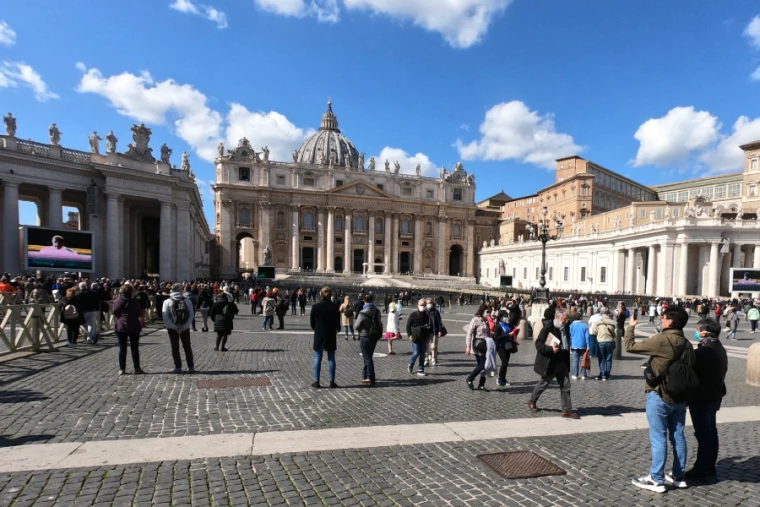
Pilgrims in St. Peter's Square watch video broadcast of the Angelus March 8, 2020. Credit: Miguel Mares.

Pilgrims in St. Peter's Square watch video broadcast of the Angelus March 8, 2020. Credit: Miguel Mares.


.- In a video streamed live to St. Peter’s Square, Pope Francis prayed for those suffering from the "coronavirus epidemic" and encouraged Catholics to live through this trial with the strength of faith.
“I join my brother bishops in encouraging the faithful to live this difficult moment with the strength of faith, the certainty of hope and the fervor of charity,” Pope Francis said March 8.
“The season of Lent helps us all to give an evangelical sense also to this moment of trial and pain,” he added.
The pope led the Sunday Angelus prayer via video filmed in the library of the Apostolic Palace in response to ongoing concerns about the spread of coronavirus in Italy and Vatican City. Traditionally, the pope leads the Angelus from the palace balcony overlooking St. Peter’s Square.
"Today's Angelus prayer is a little strange with the pope ‘caged’ in the library, but I see you, I am close to you,” Pope Francis told the smaller than usual crowd in St. Peter’s Square at the beginning of the video broadcast.
“This way of praying the Angelus today is done to carry out preventive measures, so as to avoid crowds of people, which can favor the transmission of the virus,” he said.
The Italian government imposed a strict quarantine on March 8 for northern and central regions of Italy, including Milan and Venice.
Most of the 5,883 people who have contracted Covid-19 in Italy have been in the northern regions of the country. The Italian Ministry of Health reported 76 confirmed cases in Rome’s Lazio region on the evening of March 7.
With 233 coronavirus-related deaths in Italy in two weeks -- 85 of which have occurred in the past two days -- Italy has had the most Covid-19 mortalities outside of China.
Italy’s museums, archaeological sites, concerts, and  movie theaters have all been closed until April 3, the Italian Minister of Tourism said March 8. All schools and universities will also remain closed throughout the country until March 15.
Pope Francis said March 8 that he is “close in prayer to people suffering from the current coronavirus epidemic.”
Vatican City confirmed its first case of coronavirus on March 5, and later announced that both the pope’s Angelus address and Wednesday general audience would take place over live video.
“The love of Jesus has no measure,” Pope Francis said in the video message. “It is a free, unconditional choice, a free initiative, a divine friendship that asks for nothing in return.”
“Being witnesses of Jesus is a gift that we have not deserved: we feel inadequate, but we cannot hold back with the excuse of our inability,” the pope said.
After the Angelus, Pope Francis appeared in the window of the Apostolic Palace to give a blessing to the pilgrims in St. Peter's Square.
“Jesus says to us too: ‘Stand up and do not be afraid’ … we must not forget that the baptism that we received made us witnesses,” Pope Francis

https://www.catholicnewsagency.com/news/pope-francis-be-strong-in-faith-amid-coronavirus-trial-68834

Wednesday, January 15, 2020

God's word can never be 'enchained,' pope says at audience

godsword650.jpg

Vatican City — A true apostle is one who continues to be a courageous and joyful evangelizer even in the face of persecution and certain death, Pope Francis said.


By choosing to close the Acts of the Apostles not with St. Paul's martyrdom but with his continuing to preach the Gospel even while under house arrest, St. Luke wanted to show that the word of God cannot be "enchained," the pope said Jan. 15 during his weekly general audience.


"This house open to all hearts is the image of the church which — although persecuted, misunderstood and chained — never tires of welcoming with a motherly heart every man and woman to proclaim to them the love of the Father who made himself visible in Jesus," he said.


The pope concluded his series of talks on the Acts of the Apostles with a reflection on St. Paul's imprisonment in Rome.


St. Paul's treacherous journey and adventures to "the heart of the empire," he said, did not weaken the Gospel he preached but instead strengthened it by "showing that the direction of events does not belong to men but to the Holy Spirit, who gives fruitfulness to the church's missionary action."


During his imprisonment, the pope continued, the apostle would meet with notable Jewish people in his efforts to show "the fulfillment of the promises made to the chosen people" through Christ's death and resurrection.


While not everyone was convinced by his preaching, St. Paul continued to welcome anyone "who wanted to receive the proclamation of the kingdom of God and to know Christ," which is a grace that all Christians should pray for, he said.


May the Lord "enable us, like Paul, to imbue our houses with the Gospel and to make them cenacles of fraternity, where we can welcome the living Christ, who comes to meet us in every person and in every age," Francis said.


https://www.ncronline.org/news/vatican/francis-chronicles/gods-word-can-never-be-enchained-pope-says-audience